
The audit question has changed. It used to be "show us your crimp records"; now it is "show us which lead is which, in the harness, on the vehicle." Automotive, appliance and EV customers build traceability into their quality systems — IATF-style requirements, VDA workbooks, wire-marker standards — and that traceability lives on the wire itself: number tubes, marker tubes, printed identities that survive assembly and lifetime service. Marking is no longer a labelling afterthought; it is part of the process flow.
What marking is actually for
Three traceability jobs ride on wire identification:
1. Assembly identity: the number tube or marker tells the assembler which lead goes to which pin — errors here are the most common harness defect class. 2. Batch traceability: the marking code ties the lead back to the wire lot, machine and date if a field failure occurs. 3. Service identity: repair technicians must identify a lead years later, when its colour and its memory are both gone.
Marking that is applied automatically, in the same flow as cutting and crimping, is the only marking that reliably survives: it cannot be forgotten, misread or skipped at a busy station.
The marking methods and their machines
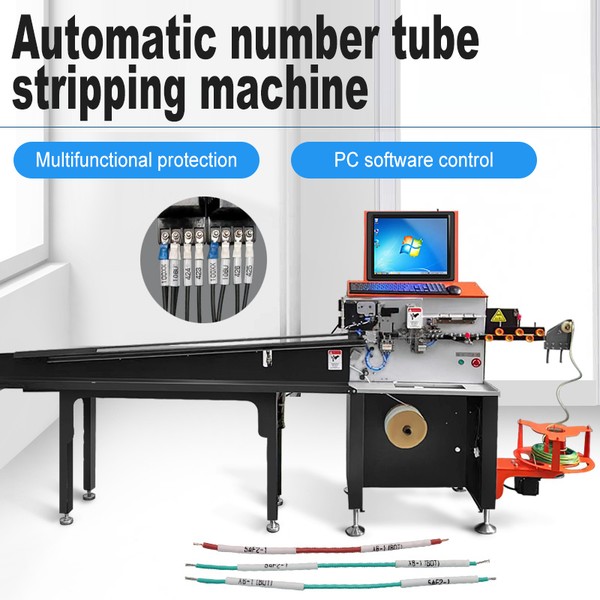
Number tubes on loose leads. A heat-shrink or nylon number tube is threaded over the wire before crimping, then shrunk or held in place. Machines that cut, strip, thread the tube and crimp in one sequence keep the tube from being the bottleneck: the TR-03H fully automatic number-tube cutting machine prepares tube stock automatically, and the TR-09G fully automatic end-piercing number-tube machine (servo/stepper driven) handles tube application as part of the wire line.
Marker tubes and double-end work. When both ends of a lead need identification, a double-end marker line applies tubes to both sides without re-handling: the TR-DM06 U-shape double-threaded numbering-tube heat-shrinkable crimping machine and the TR-2525+S double-end marker-tube machine (cutting length 66-99,999 mm) cover the range from short jumpers to long runs. Where one lead splits into three branches, the TR-DM03 one-to-three inserting-tube machine applies tubes across the branch structure in one pass.
Printed marker tubes. Printed sleeves carry text that survives assembly — wire number, circuit code, date code. The TR-CG01 automatic double-head wire marker-tube machine (cutting 180-20,000 mm, marker-tube length 20 or 30 mm, both customisable) prints and applies marker tubes at line speed; the TR-GZ520 semi-automatic number-tube terminal crimping machine (PLC/touch-screen) is the bench answer for lower volumes and frequent changes.
Which marking approach fits your line
| Profile | Approach | Machines |
|---|---|---|
| Low volume, many variants | Bench tube machine, manual change | TR-GZ520, TR-03H |
| Medium volume, standard leads | Automatic tube threading in the wire line | TR-09G, TR-DM06 |
| High volume, double-end marked leads | Double-end marker-tube automatic | TR-2525+S, TR-CG01 |
| Branching harness sections | One-to-three tube application | TR-DM03 |
Build marking into the process, and into the audit pack
Three practices make marking an audit asset instead of an audit finding:
1. Mark before crimping, not after — threading the tube before the terminal goes on means the mark physically cannot be added to the wrong lead later. This is why integrated tube machines exist and why retrofitting marks at final assembly is the expensive way to do it. 2. Make the code standardised — agree the code structure (wire number, circuit, date/batch fields) with your customer once, then keep it identical across machines and shifts so the marker text never becomes a quality argument. 3. Verify the mark like any other feature — include marking presence and legibility in the first-article check and patrols, the same way crimp height is checked in our quality audit guide.
The trend: marking joins the process line
Across the industry, marking is moving out of the labelling corner and into the processing line — cut, strip, tube, mark, crimp in one controlled flow. The reason is traceability economics: a lead that carries its identity from the first cut can be tracked, sorted and audited without a second station, a second operator or a second chance for error. For shops supplying automotive, appliance and EV customers, wire marking is no longer optional polish. It is the difference between a lead you can trace and a lead you can only hope was built right.