
Ask a harness shop owner about the biggest constraint in 2026 and the answer is rarely demand. It is people: the operators who strip, crimp and assemble leads are harder to recruit, quicker to leave, and more expensive every year. The automation response is not "replace everyone" — it is to automate the steps where labour adds the least value, and to concentrate your people where their skill actually matters. Here is how to sequence that.
Where the labour actually goes
In a typical harness shop, labour concentrates in four places: feeding and operating semi-automatic presses, double handling between process steps, quality checking by re-inspection, and assembly of the final connector. The first three are machine-shaped problems; the fourth stays human for now. Automation decisions should follow that shape — replace the repetitive handling first, keep the assembly skill in-house, and use the freed people where judgement is needed.
Step 1 — take the operator out of the press cycle
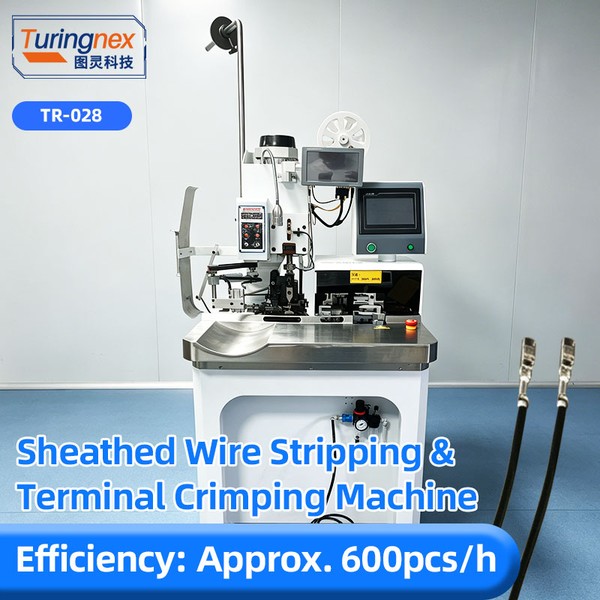
Every bench press needs hands: load wire, trigger, unload, repeat. That is the least skilled, most turnover-prone job in the shop — and the first to automate. A combined cut-strip-crimp machine removes the hand from the cycle entirely. The TR-028 sheathed-wire stripping and terminal crimping machine (PLC/touch-screen) and the TR-1800S multi-functional peeling and crimping machine take one operator from loading each piece to supervising a stream. The TR-17T fully automatic multi-core sheathed-wire double-head machine processes both ends of multi-core leads without re-handling — two handling steps gone at once.
Step 2 — one operator per line, not per machine
The economics change when one person supervises a line instead of feeding a press. Three-in-one and double-head automatics — the TR-HY03 (2,200-2,500 pcs/h, cut-strip-crimp in one pass) or the TR-TC02 double-head five-wire machine — turn "four operators, four presses" into "one or two operators, one line." The headcount you free is not a saving you pocket; it is the buffer that absorbs the turnover you cannot stop. When an operator quits next month, the line keeps running.
Step 3 — automate the quality eyes, keep the judgement
Re-inspection is labour too, and it is labour spent finding problems the process should have prevented. Automatic machines with stable servo/stepper control and PLC diagnostics (TR-028, TR-HY03, TR-1800S class) hold the process so the finished-lead check becomes a lighter patrol instead of a second workforce. The humans you keep for quality do first-article checks, pull tests and root-cause work — jobs worth paying more for, which is exactly how you keep them.
Step 4 — integrate the steps that cause re-handling
Every time a lead moves between machines, it costs a person and a queue. Integration is automation by another name: cut, strip, crimp and marking in one machine flow means the lead never leaves the process between steps. The TR-8030YJP computer-controlled stripping machine with marking function is a single station that does wire prep plus identification — two functions that otherwise need two operators and a hand-off. Our wire-processing automation trends guide looks at where this integration is heading across the industry.
Keep the skill you need
Automating the repetitive steps does not mean a skill-free shop — it means the skills change. What you now need: setup and changeover competence (fast die changes per our changeover guide), first-article quality judgement, and machine care. Plan the training shift at the same time as the machine purchase: send your best operators to supplier training when the machine lands, not after the old ones leave. A shop with two skilled line technicians and two automatic lines outproduces a shop with ten press operators and ten benches — and it survives the labour market instead of negotiating with it.
A sequencing checklist for the owner
1. Automate press feeding first — cut-strip-crimp machines (TR-028, TR-1800S). 2. Move to line supervision — double-head and three-in-one automatics (TR-HY03, TR-TC02, TR-17T). 3. Integrate marking/prep steps (TR-8030YJP). 4. Retrain your best people for setup, quality and machine care — before the machines arrive.
The labour squeeze is not going to reverse. The shops that treat it as a machine-design problem — automate the handling, integrate the steps, upskill the people — will quote shorter lead times and hold steadier quality than the shops still negotiating for press operators one recruitment ad at a time.