
A tape-wrapped end that looks acceptable to the eye can still be rejected at optical inspection. The usual cause is not the tape or the tension — it is the wrap geometry. A spiral or diagonal wrap leaves a helical edge: the end face stops on a slope, and where the first and last turns meet there is a small unfilled triangle. Vehicle manufacturers and their harness suppliers inspect exactly that point.
Why a spiral wrap leaves an edge
In a spiral wrap the tape advances along the wire while the wire rotates, so each turn is offset from the previous one and the tape border runs diagonally across the harness. That is efficient, easy to control, and for most industrial harnesses entirely adequate. The limitation appears at the ends: because the tape travels as it lays down, the final turn finishes on a slope rather than square to the wire axis.
Optical inspection systems look for a flush end face, an even border line, and no uncovered window in the insulation. A sloped end or a triangular gap fails those checks even when the wrap is mechanically sound and the harness would perform perfectly well in service.
What vertical flat taping changes
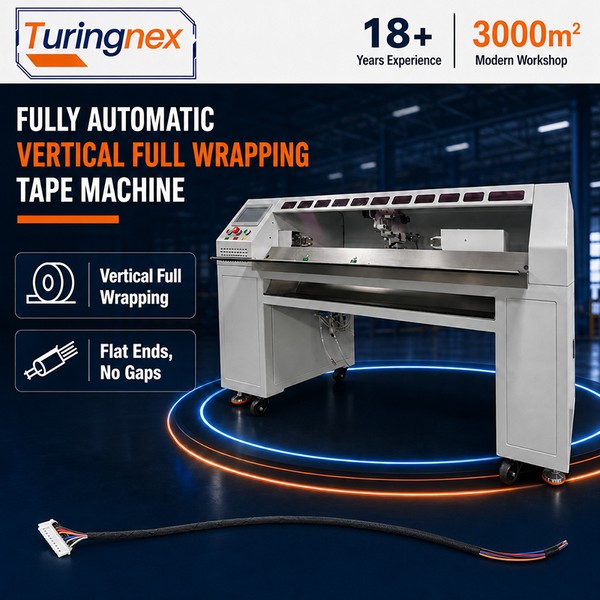
A vertical flat-taping head feeds tape perpendicular to the wire axis instead of diagonally. The tape is applied as a flat band, so both borders finish flush and the end face is perpendicular — there is no helical edge left to open a gap. On the TR-850D automatic vertical full-wrap tape winding machine the tape is applied and cut automatically, and pneumatic wire clamping holds the harness steady so the end position does not drift between the first and last turn. Tape-feed and cut are sequenced by the controller rather than by operator hand speed, which is the other common source of an uneven border.
The TR-850D covers a wire diameter range of Ф3 mm to Ф15 mm, wider than most semi-automatic tape heads, and handles full wrap and multi-segment wrap. Release-paper-backed tape — mica, ceramic, acetate cloth and high-temperature tape — is the intended material class, and a paper take-up device is available as an option.
What the specification actually controls
Three numbers decide whether a wrapped lead passes inspection: where the wrap starts and stops, how square the end face is, and whether the tape overlaps consistently along the run.
| Parameter | TR-850D vertical flat taping | TR-850C full wrap | TR-303X intelligent high speed |
|---|---|---|---|
| Wrap geometry | Vertical flat tape; flush ends, no notch or tilt | Full wrap and multi-segment wrap | Spiral; full wrap with 1/2, 1/3 or 1/4 overlap; spot and interval wrap |
| Wire diameter | Ф3-15 mm | 3-10 mm | Ф3-25 mm (to 40 mm made to order) |
| Speed | 4,500 rpm; speed setting 0-30 | Speed setting 0-30 | 4,500 rpm |
| Effective winding stroke | Within 1 m | Within 1 m | Unlimited winding length |
| End margins | First segment ≥15 mm; tail ≥10 mm | First segment ≥15 mm; tail ≥10 mm | Set per segment on the touch screen |
| Tape spool | Outer diameter ≤110 mm; bore Ф38 (optional Ф32, Ф76) | Outer diameter ≤110 mm; bore Ф38 (optional Ф32, Ф76) | Outer diameter ≤110 mm (to 170 mm made to order) |
| Control | Touch screen with PLC; pneumatic clamping 0.4-0.6 MPa | Touch screen with PLC | Touch screen with foot pedal |
| Power and size | AC 220V / DC 24V, 1,350 W; 1,830×600×1,080 mm, 300 kg | AC 220V / DC 24V, 1,350 W; 1,810×600×1,080 mm, 300 kg | AC 220V / DC 24V; 520×470×330 mm, 48 kg |
Throughput: what the 15-second figure means
The TR-850D runs a full wrap of one metre of wire in about 15 seconds at the medium speed setting. That figure is worth reading carefully, because it is quoted per metre rather than per part: a 300 mm lead takes proportionally less, while a long branch lead takes more. When comparing machines, ask suppliers for a time per metre at a stated speed setting rather than a headline rate, so the comparison is like for like.
A 1,350 W drive and pneumatic clamping are what allow that rate to be held on release-paper-backed tape, which is heavier and stiffer than PVC electrical tape and will not tolerate a tape head that simply pulls it off the roll.
Choosing between the two geometries
- OEM automotive harnesses with optical inspection: vertical flat taping. The requirement is usually written as “both ends flush, no notch, no tilt”, and a spiral head cannot guarantee it.
- General industrial harnesses, cabinet wiring, corrugated tube: spiral wrap is faster to set up and covers unlimited lengths. The TR-303X intelligent tape winding machine handles Ф3-25 mm and brings settable overlap ratios.
- Long, heavy harnesses where the operator cannot hold the wire steady: look at a machine that clamps the wire for you. Hand-fed wrap uniformity depends on pulling speed, which is exactly what varies between operators.
Options worth ordering with the machine
Two options are commonly specified together with the tape head. A paper take-up device peels and rewinds the release-paper backing in step with the wrap, which matters for mica, ceramic and acetate cloth tapes. A safety light curtain stops the machine when an operator reaches into the winding area — worth having when the head runs at 4,500 rpm and the clamping is pneumatic.
Questions to settle before you buy
- What is the exact end condition the inspection rejects — slope, gap, notch, or covering distance from the terminal?
- What wire diameter range must one machine cover, and is a raised frame needed for anything above Ф25 mm?
- Which tapes must run, and do any of them carry release-paper backing?
- How long is the longest wrapped segment, and does the standard 1 m stroke cover it?
- Is the machine going into an automatic line, in which case wire clamping, feeding and cutting have to be automated rather than operator-driven?
Send us a wrapped sample and the inspection standard it has to meet, and we will confirm which head geometry and tape handling you need before you commit to a machine.