
Tube cutting machines cut in one of two ways. A rotary head spins a blade around the tube, which gives a flat end but takes a lighter bite. A pneumatic cylinder drives a blade straight through, which gives force but deforms soft tube.
Rotary cutting
The blade travels around the tube and advances slowly into it. Because material is removed progressively rather than punched through, the cut face stays flat and the tube keeps its round section. The machine-side consequences are a lower blade-feed stroke, a servo-driven rotary head, and a clamping system that has to hold the tube without crushing it.
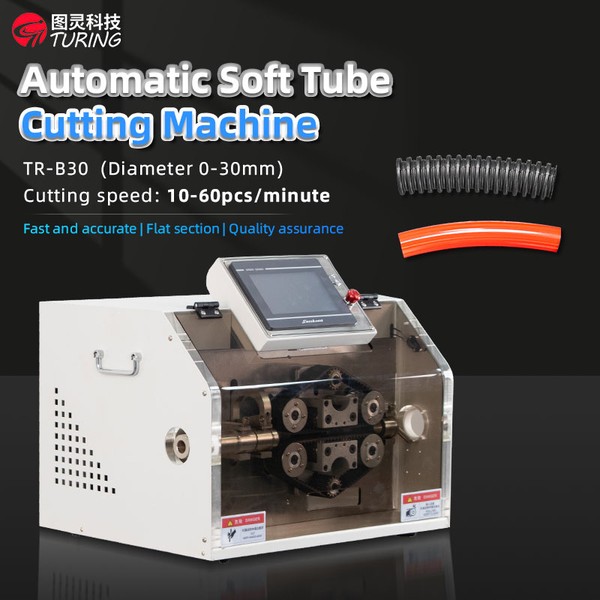
The TR-B30 range is the general-purpose family for nylon hose, corrugated hose, rubber hose, silicone hose and plastic tube, described as efficient and stable with a flat cut. Within the family, the rotary-head version is specified for 'slightly harder tubes such as nylon hard tube and PVC tube', where rotary cutting is stated to give a flatter and smoother cut.
Its documented figures are: cutting method rotary, blade feed stroke 8 mm, digitally adjusted tube clamping, 400 W servo rotary motor, 220 V 50-60 Hz, 750 W, cutting diameter Ф5-Ф42 mm, length tolerance cutting length x 0.001 ± 0.2 mm (PVC, when L is below 1000 mm), and 10-60 pieces per minute depending on length.
Cylinder cutting
A pneumatic cylinder drives the blade through the tube in one stroke. That gives considerably more force, which is what you need for thick rubber or PVC of a certain hardness, and it is why the cylinder family is described as 'cylinder cutting for greater power'.
The trade-off is on soft or thin-wall tube: a single hard stroke can ovalise the section and pinch the wall. On corrugated tube it can also collapse the crests adjacent to the cut.
| Parameter | Rotary head | Cylinder head |
|---|---|---|
| Cutting method | Rotary cutting | Cylinder cutting |
| Stroke | Blade feed stroke 8 mm | 60 mm |
| Cutting diameter | Ф5-Ф42 mm | Ф5-Ф60 mm |
| Power | 750 W (400 W servo rotary motor) | 500 W |
| Length accuracy | L x 0.001 ± 0.2 mm (PVC, L below 1000 mm) | ±0.5 % of cutting length |
| Speed | 10-60 pcs/min | 10-60 pcs/min |
| Air supply | 0.5-0.7 MPa | Required (cylinder drive) |
| Best for | Nylon hard tube, PVC, thin-wall tube | Thick rubber, hard PVC, larger diameters |
Materials that need a third answer
Some tubes defeat both heads in their standard form. Steel-wire-reinforced tube, tube with a metal braided layer and PTFE tube need a dedicated configuration rather than a different blade. Corrugated tube has its own problem, which is not the cut quality but where the cut lands — if the end has to finish on a crest or in a trough, the machine needs to see the tube rather than just measure it.
Adjacent functions worth bundling
Three functions are commonly ordered with the cut. Slitting opens the tube lengthwise without removing material, which is how a tube is fitted over a harness that is already terminated. Take-up collects cut pieces instead of letting them drop. Tape wrapping applies tape at both ends as part of the same cycle. On wide corrugated tube a dedicated slitting variant is the usual choice rather than adding slitting to the standard machine.
How to specify
Give the tube material and hardness, the outside diameter, the wall thickness if it is a single-wall tube, the cut length and its tolerance, and whether the cut face has to be square or is hidden inside a connector. Then say whether the end must land on a feature of the tube — for corrugated tube that single answer changes the machine.