
What tin dipping actually does
Dipping the stripped end of a wire into molten solder tins the strands: it stops oxidation, binds loose strands together and improves solderability for the next process — terminal soldering, through-hole joints or solder-seal crimping. It is a small process with a big effect on joint reliability, which is why dipped ends appear wherever solder joints are specified (appliance leads, relays, sensors, audio and some automotive subassemblies).
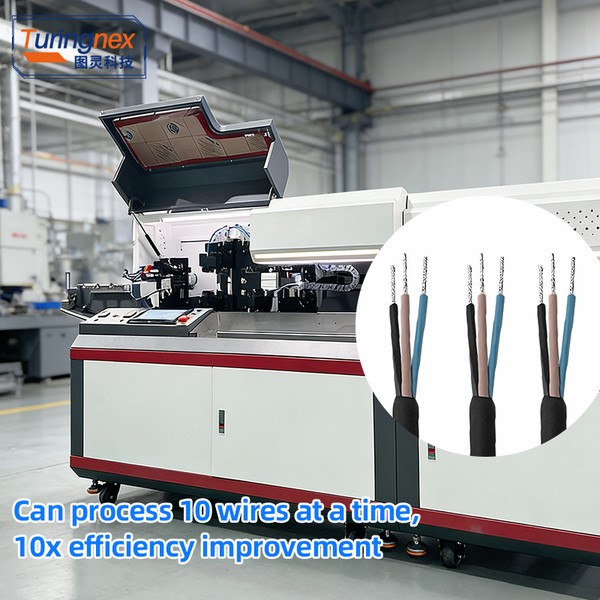
But not every wire needs dipping, and not every shop needs a machine. This guide covers when dipping is required, what a tin-dipping machine must do well, and how to size it.
When dipping is required — and when it is not
Dipping is typically required when:
- the downstream process is soldering and the wire end must wet reliably (unfluxed, oxidised strands reject solder);
- the spec calls for tinned ends for corrosion resistance or assembly;
- stranded conductors must stay together through handling before termination.
Dipping is usually not required when:
- the terminal is crimped only (no solder joint downstream);
- parts are welded rather than soldered;
- oxidation between process steps is controlled another way (short storage, sealed reels).
If crimping is the final joint, a dipping step adds cost and a process variable for no benefit — a good supplier will tell you this before selling you the machine.
What the machine must control
| Control | Why it matters | What to check |
|---|---|---|
| Solder bath temperature | Too hot burns the insulation; too cold gives dull, poorly wetting dips | Closed-loop control, set by solder alloy |
| Dip depth | Deep enough to tin the stripped length, shallow enough to spare insulation | Adjustable stroke / depth stop |
| Dwell time | Consistent coating thickness | Timed dwell per cycle |
| Fluxing | Clean oxide before dipping | Flux station before the bath, or flux-cored handling |
| Fume extraction | Solder fumes are a health and compliance issue | Hood + extraction ducting |
| Bath capacity & dross handling | Output and coating quality over a shift | Tin capacity, easy dross skimming |
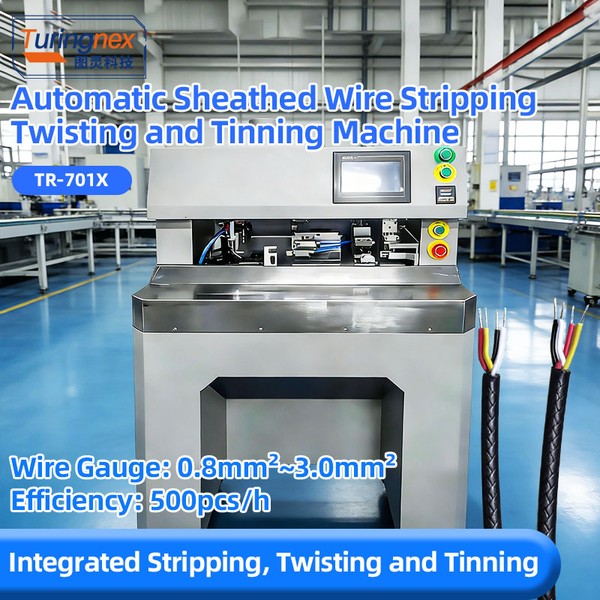
A full automatic dipping-tin terminal crimping machine adds automatic feeding of stripped leads, which is where the throughput story changes for high-volume lines.
Dipping into a solder-seal process
Tin dipping and solder-seal crimping are cousins: both put solder at the wire-to-terminal joint. Dipping tins the bare wire end for later soldering; solder-seal crimping (also called preform soldering) crimps a terminal with a solder ring and then heats it to make a sealed, soldered joint in one operation — see our companion guide on crimp-and-seal automation options. Choosing between them depends on whether your terminal design accepts a solder preform.
Sizing and buying checklist
1. Output. Count stripped ends per day. A semi-auto dipping station suits up to a few thousand ends/shift; sustained high volume points to the automatic dip-tin machines fed from your stripping/crimping line. 2. Wire range. Confirm the machine dips your smallest to largest stripped lengths without setup chaos — mixed sizes favour adjustable depth with quick changeover. 3. Solder alloy. Tin/lead and lead-free baths run at different temperatures; confirm the machine's range covers your alloy and that temperature control suits lead-free. 4. Safety and compliance. Fume extraction, splash guarding and insulation protection (the dip must not wick up and melt insulation) are not optional. 5. Sample test. Ask for dipped samples at your production settings; check wetting, coating uniformity and insulation condition.
FAQ
Is dipping the same as tinning by hand? The process is similar, but a machine controls temperature, depth and dwell — the three variables that make hand-dipped ends inconsistent.
Does dipping hurt the insulation? Only if temperature, depth or dwell are wrong. Correctly set, the solder wets only the stripped conductor; the insulation is never immersed.
Can one machine handle leaded and lead-free solder? You generally commit a bath to one alloy. Changing alloys means emptying, cleaning and re-timing the bath — plan machines per alloy if you run both.
Bottom line
Buy a tin-dipping machine only when your soldered joints need tinned ends at volume — then buy one that controls temperature, depth and dwell, extracts fumes and matches your output. Send us your wire range, alloy and daily volume; we will quote the right station and dip a sample so you can see the wetting before you decide.