
Thermal protectors and NTC temperature sensors are the smallest safety-critical components in appliances, power tools, battery packs and EV auxiliaries — and they are getting smaller while quality audits get stricter. For manufacturers of protector leads and sensor assemblies, the practical question is not whether to automate welding, but which process configuration will hold up for the next order book. This article looks at four trends shaping thermal protector and NTC welding, and what each means when you evaluate a machine.
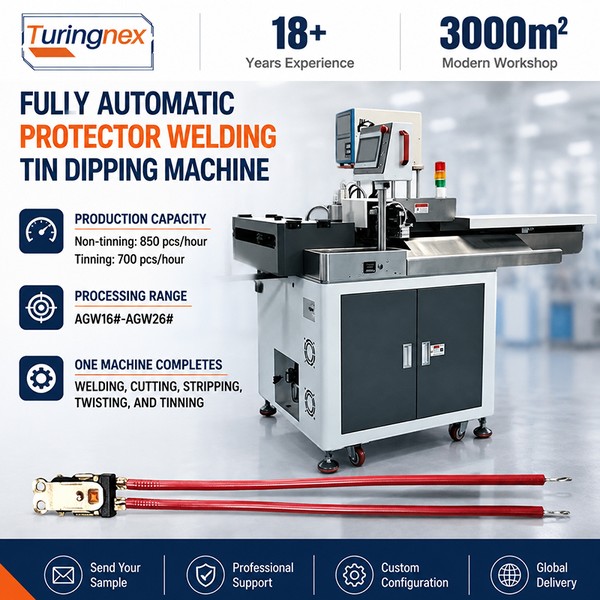
Trend 1 — one machine, two finished states: tinned or non-tinned
Protector leads ship in two versions: bare welded joints and solder-dipped (tinned) joints, depending on the customer's downstream soldering process. Running both on separate lines doubles tooling; running them on one machine used to mean slow changeovers.
Modern protector welding machines answer this with a dual-mode station. The TR-WK02 fully automatic thermal protector welding machine welds protectors in either mode on one line — non-tinning at up to 850 pcs/h, and tin-dipping at up to 700 pcs/h — with the solder dip switched by process recipe rather than by re-tooling. For a component supplier quoting mixed orders, that dual capability is inventory flexibility as much as machine capability: you accept the job, then set the mode.
Trend 2 — welding smaller wire without sacrificing stability
As protectors shrink, so do their leads: today's spec sheets routinely call for AWG16#–AWG26# conductors, including 0.8 mm and 1.0 mm bare copper. At that scale, weld quality depends on the power source being stable at low energy, not just powerful. The TR-WK02 runs its welding station from an inverter power supply (380 V), which keeps current delivery consistent shot after shot — the difference between a weld that looks good once and a weld that is statistically repeatable across a shift. When you compare machines, ask for the power-source topology, not just the "welding current" headline.
Trend 3 — the process is a chain, and the chain is being automated end to end
A protector or NTC assembly is rarely one weld. The typical chain is: arrange the sensor/resistor → weld its leads → rivet copper strips → tin the ends. When each step is a separate manual station, the yield loss hides between stations — parts dropped, leads mis-oriented, ends half-tinned.
Welding automation now ships as matched stations for each step of that chain:
- TR-GY01 NTC resistance typesetting and welding machine automates the front of the chain — wire cutting, stripping, terminal crimping, tin dipping and typesetting of the NTC resistor into the welding position — with compressed-air actuation (0.5–0.7 MPa) and single-phase 220 V supply.
- TR-NTC automatic copper strip riveting and tinning machine covers the copper-strip side, riveting and tinning the ends in one automatic sequence (tinned ends, not sleeved), which is the joint style many protector assemblies specify before final over-moulding or sleeving.
- TR-WK02 completes the line with protector welding in either tinned or non-tinning mode.
Buying the steps as one coordinated family matters for two reasons: the stations are engineered around the same workpiece formats, and one supplier carries the process responsibility end to end — which is what "professional" looks like when your auditor visits.
Trend 4 — quality evidence, not just quality
The biggest trend is documentation. Appliance and EV customers increasingly want process evidence per batch: which machine made the parts, in which mode, at what settings. That pushes machine choice toward:
- Recipe-based settings. Dual-mode and multi-size machines that store parameters per product mean the operator selects the recipe; the machine applies the proven settings instead of "tuning by feel".
- Stable, auditable process conditions. Documented air pressure, inverter welding supply and timed dip cycles are the data points an audit trail is built from.
- A supplier who can quote the process. When you ask for a protector welding line, the supplier should be able to lay out the step chain and the machine for each step — see the roles below — rather than selling "a welder".
| Chain step | Machine (Turingnex) | What it automates | Real capability highlights |
|---|---|---|---|
| NTC arrange + lead weld | TR-GY01 | Cut, strip, crimp, tin-dip, typeset, weld NTC leads | Single-phase 220 V, air 0.5–0.7 MPa |
| Copper-strip rivet + tin | TR-NTC | Copper strip riveting and end tinning (not sleeved) | Automatic sequence, tinned ends |
| Protector welding (both modes) | TR-WK02 | Weld protectors, with/without tin dipping | AWG16#–26# (0.8/1.0 mm); 850 pcs/h non-tin, 700 pcs/h tin-dip; inverter 380 V |
What to ask a machine supplier in 2026
1. Can the welder run tinned and non-tinned joints on the same line without re-tooling? 2. What wire range is *certified* — and does the power source stay stable at the low end (0.8–1.0 mm bare copper)? 3. Which upstream steps (cutting, stripping, typesetting, riveting) are automated in the same family, so the chain has one owner? 4. What process parameters are documented per batch for an audit?
Those four questions separate process partners from machine sellers — and they are exactly the questions we built the TR-WK02, TR-NTC and TR-GY01 machines to answer.
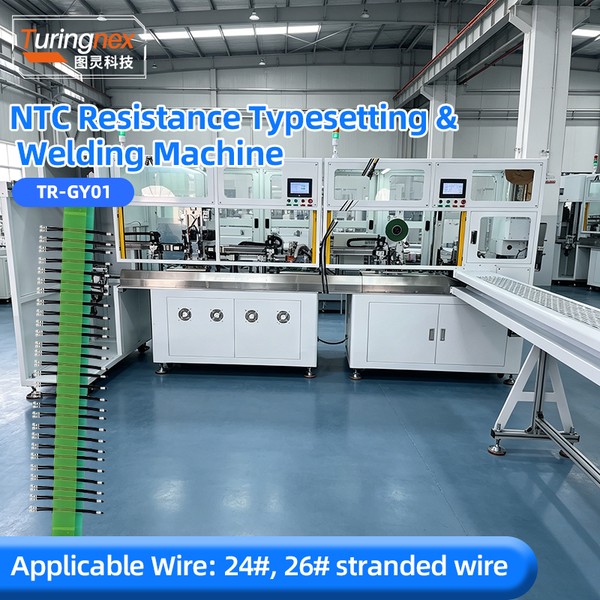
Arrange & weld NTC leads
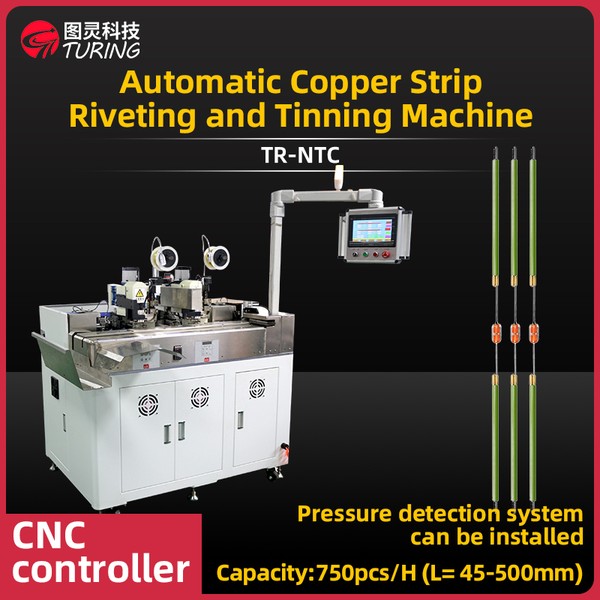
Rivet copper strips & tin ends
Weld protectors, tinned or plain
FAQ
Do thermal protector leads really need tin dipping? Only when the customer's downstream assembly is soldering. That is why dual-mode machines exist — you run non-tinned for crimp/over-mould customers and tinned for solder customers without a second line.
Why does the welding power supply matter for small wire? Small conductors need low, stable weld energy. An inverter supply holds the current consistent cycle to cycle; a less stable source drifts as it warms up, and the drift shows up as intermittent weak welds.
Can I build a full NTC/protector line from these machines? Yes — the three machines cover the typical chain from NTC arranging and lead welding through copper-strip riveting/tinning to protector welding. Send us your sample and target output and we will confirm the line configuration.
Bottom line
Protector and NTC welding is moving toward dual-mode flexibility, stable small-wire welding, end-to-end process automation and audit-ready documentation. Machines engineered as a matched chain — TR-GY01 → TR-NTC → TR-WK02 — let you quote mixed orders, hold weld quality on fine wire and show your customer the process evidence they ask for. Tell us your protector sizes and monthly volume; we will propose the line and run samples before you commit.