
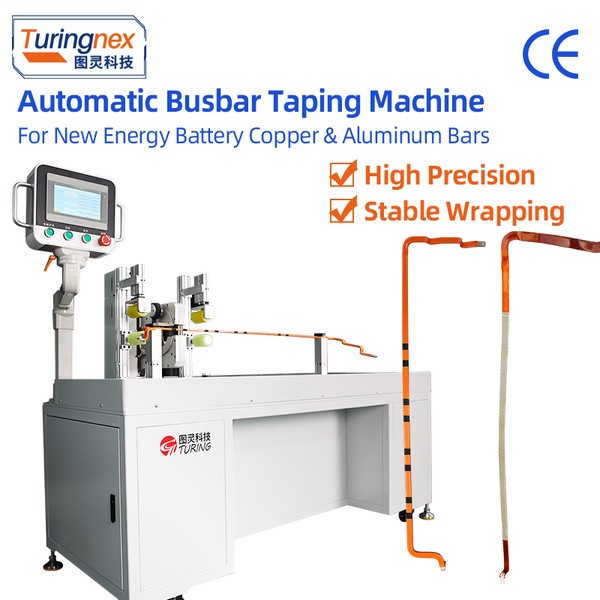
Copper and aluminium busbars for battery packs and high-voltage distribution are long, flat, thick and easily deformed. Taping them is not a wrapping job in the usual sense: the tape is applied at defined points and at defined lengths along a workpiece that may be 1.5 m to 1.8 m long, and the workpiece cannot be brought to the tape head in the way a short harness can.
Why ordinary spot winders fall short
A standard spot-winding machine holds the workpiece on a bed and brings the tape head to a position. That works well up to roughly a metre. Beyond that the workpiece overhangs the bed, and the further the head travels from the drive, the more the positioning accuracy and the clamping rigidity fall away. On a long busbar the specification that matters is therefore not the speed of one wrap but the accuracy held along the full stroke, and the clearance available at each end.
What long-stroke bidirectional winding provides
The TR-950C automatic spot winding machine is built on a long-stroke bidirectional carriage: the effective winding stroke is 1,800 mm in each direction, so a head can travel the full length of a long workpiece from either end without the operator repositioning it. Servo positioning holds overlap and position accuracy to ±1 mm, and the workpiece length range is 200-1,800 mm with at least 60 mm of end clearance.
After the workpiece is placed, clamping, winding and tape cutting are automatic; the maximum winding rate is 80 mm per revolution of the workpiece. The working envelope covers copper busbars up to W25×H3 mm and wire diameters of Ф10-25 mm, with tape up to 25 mm wide and a spool outer diameter up to 110 mm.
The numbers along the whole stroke
| Parameter | TR-950C long-stroke spot winder |
|---|---|
| Winding mode | Spot winding, forward and reverse, bidirectional |
| Effective stroke | 1,800 mm × 2 |
| Workpiece length | 200-1,800 mm (end clearance ≥60 mm) |
| Workpiece range | Ф10-25 mm; copper busbar up to W25×H3 mm |
| Accuracy | Overlap and position ±1 mm |
| Winding rate | Up to 80 mm per revolution |
| Tape | Width ≤25 mm; spool outer diameter ≤110 mm |
| Control | PLC with touch screen; multi-recipe recall; automatic clamping, winding and cutting |
| Power and air | AC 220V 50 Hz, 1,500 W; air 0.5-0.7 MPa |
| Machine size and weight | L2,200×W750×H1,490 mm, approx. 320 kg |
| Export crate | Approx. 2,300×850×1,600 mm, approx. 380 kg gross |
Plan the floor space and the crate
Two practical consequences follow from a 1.8 m stroke. The machine is 2.2 m long, and the export crate is roughly 2.3 m × 0.85 m × 1.6 m at about 380 kg gross — so the unloading bay, the door width and the floor position all need checking before the order is placed, not after. Air at 0.5-0.7 MPa is required, and the machine needs a stable, level floor because the carriage length amplifies any deviation.
When a shorter machine is the better answer
- Workpieces up to about a metre: a standard spot winder reaches the same accuracy with a smaller footprint. There is no benefit in paying for stroke you do not use.
- Short busbars and harness nodes: a compact bench-top spot winder completes a single winding point in a few seconds and occupies a fraction of the floor area.
- Continuous wrap along a long flexible wire, not spot wraps: a long-stroke spot winder is the wrong family. Look at a full-wrap tape head with an unlimited winding length instead.
What to send with an enquiry
- The busbar drawing, including overall length, cross-section and the taper or bend at each end.
- How many taping points per workpiece, and the length and number of turns at each point.
- The tape specification, including backing paper if present.
- The required position tolerance and how it is inspected.
- Parts per shift, so the cycle can be matched to the operator loading time.
A busbar drawing and the taping callout are enough for us to confirm stroke, clamping and tape handling.