
"Tape wrapping" is four different processes
Ask for a "tape wrapping machine" and you can be quoted four very different machines. Spiral (half-lap) wrapping leaves cable flexible but partially exposed; full wrapping covers the cable completely with butted or overlapped tape; single-point taping fixes one point on a harness; copper-foil wrapping adds shielding. Choosing the wrong one means either overpaying for protection the cable never needed or shipping a harness that fails its flex or shielding test. This guide sorts the four families by what the finished cable must do.
The four wrap families compared
| Process | What it produces | Typical use | Key parameters |
|---|---|---|---|
| Spiral / half-lap wrap | Tape wound at an angle, gaps between turns | Abrasion protection with flexibility | Lay angle, overlap %, tension |
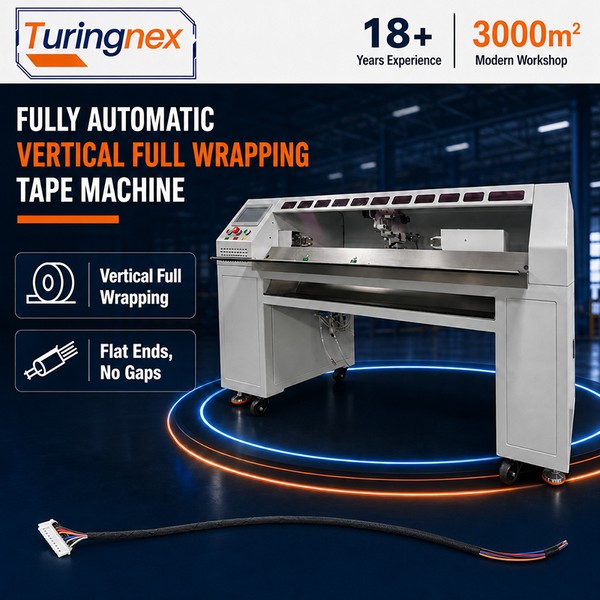
| Full wrap | Tape applied 100% coverage, butted or overlapped | Maximum abrasion/insulation, tidy bundles | Overlap, tension, edge alignment |
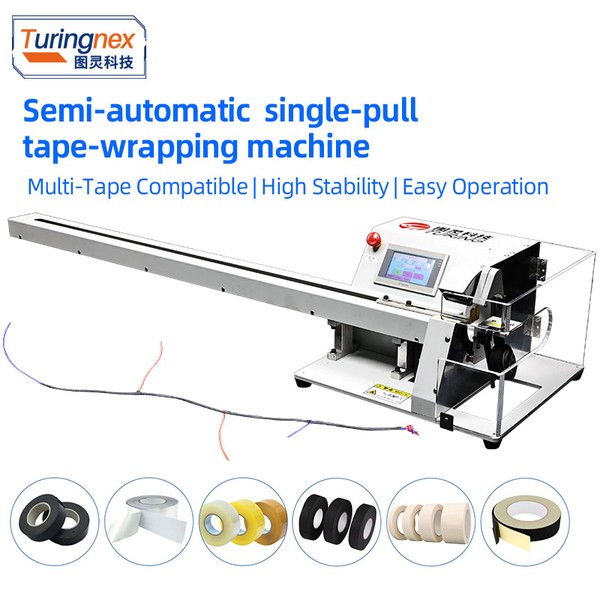
| Single-point taping | One short band at a fixing point | Keeping bundle joints, labels or clips in place | Band width, wraps per point |
| Copper / foil wrap | Conductive tape layer | Shielding and grounding | Overlap, conductivity, tear-off |
Full-wrap and spiral machines also differ mechanically: a full-wrap head spins the tape reel around a stationary bundle, while a spiral head advances the reel along the bundle at a set angle. Our full tape wrapping machines and single-point tape wrapping machines cover the main harness families; copper-strip tape wrapping machines handle shielding layers.
Decision 1: what does the cable need to survive?
- Flexing in service? A tight full wrap restricts flex and can crack. Spiral wrapping — typically 25–50% overlap — protects while staying flexible.
- Full coverage demanded by the spec? Automotive engine-harness specs often require full-wrap protection over certain zones. If the drawing says "100% coverage", a spiral machine cannot pass it regardless of overlap claims; you need a full-wrap machine.
- Just holding parts together? That is a bundling or single-point job, and a tape bundling machine or cable winding and bundling machine is the economical choice.
Decision 2: lay, tension and overlap
Three parameters decide whether a wrap looks and works right:
1. Overlap (lay). For spiral wraps, the standard is half-lap (50%) for protection or a wider pitch for cost saving. Confirm the machine can hold the chosen pitch across speed changes — pitch drift makes the wrap look uneven and leaves unprotected gaps. 2. Tension. Too low and the tape wrinkles and later unwinds; too high and stretchy tapes neck down or crack on curves. Tension must be adjustable per tape material. 3. Tape width and edge alignment. Full wrap needs accurate edge control so butted turns do not overlap or gap. For foil, edges that touch wrongly break the shielding continuity.
Decision 3: volume, bundle diameter and changeover
- Bundle diameter range. Some machines handle 1–10 mm, others 5–30 mm. Buying a machine whose minimum diameter is above your thinnest cable forces you to pad the bundle — an instant quality problem.
- Changeover. If your day mixes 3 mm and 20 mm bundles with different tapes, quick head and guide changes matter more than peak speed. Count changeover time per day, not just parts per hour.
- Feeding the tape. Long runs justify reel-based feeding with auto-splice; short runs may prefer simple manual tape loading.
Practical checklist before you buy
1. Write down the finished-cable requirement: flex test? coverage spec? shielding? — this decides spiral vs full wrap vs foil before any price comparison. 2. Measure your bundle range and confirm the machine covers it without padding. 3. Ask for a sample wrap on your own cable and tape, and check overlap consistency at both slow and full speed. 4. Verify tension control range against the tapes you actually use (cloth, PVC, foil). 5. If you bundle multiple families, compare full setup including changeover time. See our tape wrapping and bundling selection guide for the full process-family comparison.
FAQ
Can a spiral machine do full wrap? No — spiral wrapping inherently leaves a pitched gap unless overlap reaches the point where turns butt, which is not how the machine is normally set or die'd. Choose the machine by the coverage your spec requires.
What overlap should I use? 50% half-lap is the safe default for abrasion jobs; lower overlap saves tape but reduces coverage. Your customer spec should state the requirement — make the machine hold it.
Does full wrap slow the line down? Full-wrap heads are often slower per metre than spiral because coverage per pass is complete; that is the trade for protection. Sizing should compare finished-metres per hour at the required coverage, not bare spindle speed.
Bottom line
Choose the wrap by the cable's job spec first, then by diameter range, tension control and changeover. If the drawing demands full coverage, buy a full-wrap machine; if it demands flexibility with abrasion resistance, a spiral machine at consistent half-lap will serve you better and cheaper. Send us your cable diameters, tape type and the finished-part requirement — we will point you to the right machine family, even when it is not the one you first asked about.