
Round sheathed cables — the two-core and multi-core jacket wires used in sensors, appliance leads and automotive branches — go through a process chain that looks simple on paper and is hard on the shop floor: strip the outer jacket without nicking the cores, separate the colour-coded cores, strip and terminate each core, thread a heat-shrink tube over the joint, bake the tube, and finally insert the finished cores into the plastic housing in the correct colour order. Every step has its own failure mode, and the failures hide inside the housing. This guide maps the three machines we build for this chain — TR-DM07, TR-JCB01 and TR-M9 — and helps you choose by line strategy rather than by habit.
The chain, and where it usually breaks
For a typical 5-pin round sheathed lead, the manual or semi-automatic route is: strip jacket, split and strip cores, crimp terminals, thread tube, bake, insert shell in colour order. The yield losses sit in two places: jacket stripping that nicks cores, and shell insertion where a wrong colour order or a half-seated terminal is invisible after the shell closes. That is why automation in this process is moving toward vision-verified, integrated cells — the trend we return to at the end of this guide.
Machine 1 — TR-DM07: high-rate jacket preparation with tube threading
The TR-DM07 automatic double-head round jacket cable machine is the volume machine for the upstream part of the chain. It works round sheathed wire (outer diameter roughly 3-7 mm, AWG 20-28), strips and processes both ends, and inserts the heat-shrink tube before terminal crimping — with servo and stepper drives holding repeatability.
- Function position: double-ended sheathed-wire preparation: strip jacket and cores, thread heat-shrink tube, crimp terminals — up to 1,000 pcs/h at 5-pin, 150 mm lead length (product page for range data).
- Cutting accuracy: adjustment within 0.5 mm plus 0.2% of cut length.
- Best for: lines that need fast, consistent jacket-and-tube preparation and will handle shell insertion on a separate station.
Machine 2 — TR-JCB01: flexible plastic-shell insertion with colour verification
The TR-JCB01 semi-automatic stripping and punching plastic shell terminal crimping machine covers the shell side of the chain as a flexible station: unwinding, straightening, cut flush, stripping, continuous header, threading and closing can run in one sequence, and the machine can be equipped with a CCD colour-sequence inspection plus rubber-shell insertion and pressure inspection to stop riveting/pressing defects from flowing out.
- Function position: plastic-shell insertion for colour-coded cores; semi-automatic, so changeover between shell types is fast.
- Real output examples: 5-core wire, single end stripped and inserted into the shell at about 276 pcs/h; 5-core wire stripped and shelled at both ends at about 938 pcs/h.
- Best for: high-mix production where shell types change often and an operator can feed and supervise the station.
Machine 3 — TR-M9: the integrated round-sheathed-wire cell
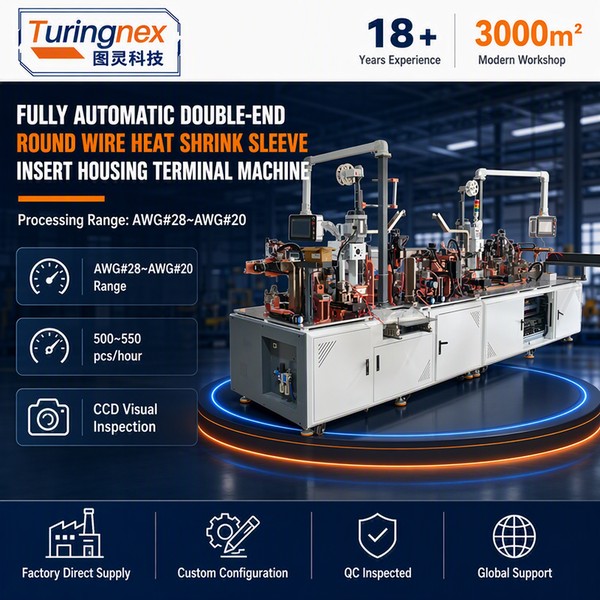
The TR-M9 automatic double-end crimping machine for round sheathed wire with heat-shrink tube and housing insertion is the machine we built to close the whole chain in one flow — and, to our knowledge, the industry's first integrated round-sheathed-wire machine to combine housing (shell) insertion, heat-shrink tube threading and baking, and colour-sorted core insertion in a single automated process, breaking the long-standing difficulty of automating jacket-cable shell insertion with baked heat-shrink protection.
- Integrated process: from jacket wire in, the machine handles double-end processing through tube and housing insertion, with baking integrated into the flow — replacing the separate bake station and the manual colour-order step.
- Vision and quality control: a dual-channel Hikvision CCD system checks core colour errors, stripping defects, terminal appearance, housing seating position and missing terminals/tubes/housings, combined with air-pressure and crimp-force monitoring (Huizhong force monitor, 2-ton crimp unit); defective parts are automatically separated, with qualified yield held to a 3‰ defect level.
- Working range: AWG 28-20 wires (subject to actual dimensions), 2P-10P universal housings, heat-shrink tubes of 4-12 mm outer diameter, cutting length 130-1,500 mm (customisable); output 500-550 finished sets per hour for leads up to 1,000 mm.
- Best for: single high-volume products where one integrated, vision-audited cell replaces a line of stations.
Choosing by line strategy
| Machine | Role in the chain | Automation level | Key real numbers | Choose when |
|---|---|---|---|---|
| TR-DM07 | Jacket strip + tube threading + terminal crimp, double head | Fully automatic | ~1,000 pcs/h (5-pin, L150 mm); OD 3-7 mm; AWG 20-28 | High-rate preparation; shell step kept separate |
| TR-JCB01 | Plastic-shell insertion, colour-checked, semi-auto | Semi-automatic | ~276 pcs/h single-end insert; ~938 pcs/h both ends (5-core) | Frequent shell changes, mixed orders, operator-led line |
| TR-M9 | Integrated strip→tube→bake→shell insertion w/ CCD | Fully automatic cell | 500-550 sets/h (≤1,000 mm); 2P-10P shells; tube OD 4-12 mm | High volume, one product family, audit-grade QC |
The trend: from stations to vision-verified integrated cells
Three industry trends are visible in sheathed-wire harness lines:
1. Integration removes handling. Every manual transfer between stations is a misalignment, a dropped part or a wrong colour order. Machines that keep the lead inside one flow — the TR-M9 approach — remove the defects that live between stations. 2. Vision becomes the inspector. Colour-sequence verification was historically an operator's job. Dual-channel CCD inspection plus crimp-force monitoring turns "inspect at the end" into "verify in the process", with automatic rejection at a controlled defect level — the standard automotive and appliance auditors now expect. 3. Flexibility by recipe and range, not by tooling. Universal 2P-10P housing compatibility, tube diameters from 4 to 12 mm, and customisable cutting lengths mean the same machine serves several products; the differentiator is how fast a verified recipe changes over, not how many machines you own.
If your roadmap is step-by-step automation, the sequence we recommend is: TR-DM07 first for preparation throughput, add TR-JCB01 for flexible shell insertion with colour inspection, and move to the TR-M9 integrated cell once one product family reaches the volume that justifies closing the chain.
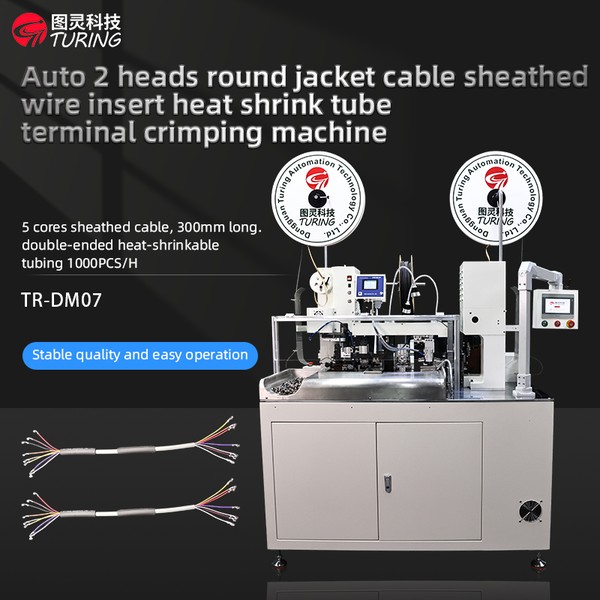
High-rate jacket prep + tube threading (to ~1,000 pcs/h)
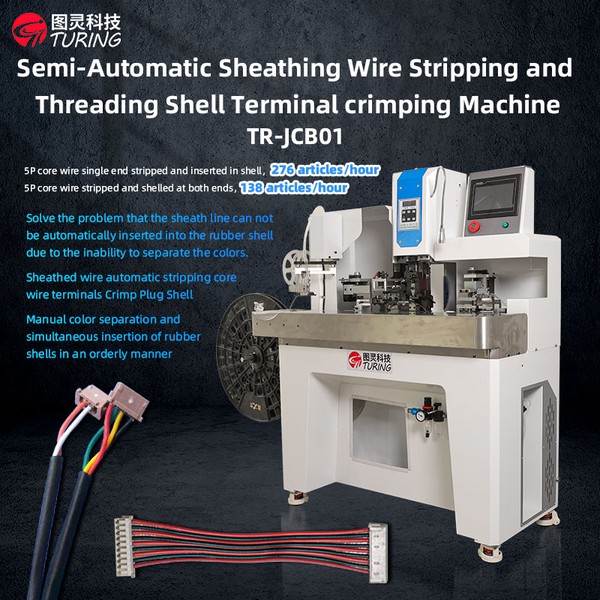
Flexible shell insertion, colour-checked (semi-auto)
Integrated cell: strip, tube, bake, insert shell (500-550 sets/h)
FAQ
Does the TR-M9 really integrate tube baking with shell insertion? Yes — that combination is the core of the machine's design and, as far as we know, an industry first for round sheathed wire: housing insertion, heat-shrink tube threading and baking, and colour-sorted core insertion run in one integrated process instead of separate stations. Confirm process details against your samples with our engineers.
What wire and shell range do these machines cover? TR-DM07 handles about AWG 20-28 with OD 3-7 mm; TR-M9 covers AWG 28-20, universal 2P-10P housings and tube OD 4-12 mm with cutting length up to 1,500 mm, customisable to your sample.
Why does colour sequence matter so much in shell insertion? Because a wrong colour order inside a closed shell is not visible after assembly and fails at the customer's end. CCD colour-sequence inspection (standard on TR-M9, optional on TR-JCB01) catches it at the machine.
How fast is "fast enough" for this process? Set the target by your downstream testing capacity, not the machine nameplate: TR-DM07 runs about 1,000 pcs/h at 5-pin 150 mm, TR-JCB01 inserts about 276 shells/h single-end (938/h both ends shelled), and TR-M9 delivers 500-550 finished sets/h up to 1,000 mm lead length. We will map your mix against these numbers before recommending.
Bottom line
Round sheathed-wire production is a chain of steps where defects hide between stations and inside the shell. Choose your machine by line strategy: TR-DM07 for high-rate jacket and tube preparation, TR-JCB01 for flexible, colour-checked shell insertion, and TR-M9 for the integrated vision-verified cell that closes the chain. Send us your sample wire, shell drawing and target volume — we will run the parts and confirm which of the three strategies fits your line.