
Two drives, two different cost curves
Walk any harness shop and you will hear the same question: *"Why pay several times more for a servo press when a pneumatic press does the same crimp?"* The honest answer: for many simple, low-volume jobs a pneumatic machine is the right buy — but the difference is not "same crimp, higher price". It is a different quality-control model. This guide explains what each drive actually does, where each earns its keep, and how to calculate payback instead of guessing.
How the two drives crimp
Pneumatic crimping machines
A pneumatic press stores energy in compressed air and slams the ram down at high speed. Crimp depth is set mechanically by adjusting the die-closing height (the "bottom stop"), and the operator — or a sensor — checks the result.
- Pros: low first cost, fast cycle, simple maintenance, familiar to every shop.
- Limits: crimp height drifts as air pressure fluctuates, seals wear and dies settle; there is no inherent feedback that the terminal is actually fully seated before the press fires.
Servo crimping machines
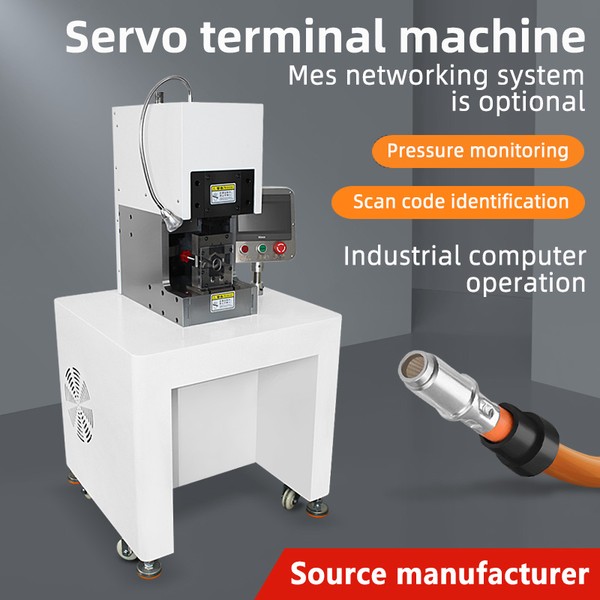
A servo press drives the ram with a motor and ball screw under closed-loop control. The controller tracks position *and* force through the whole stroke, every cycle.
- Pros: each cycle is force-monitored; wrong terminal, missing wire or a worn die is detected in the stroke itself; process data can be logged per crimp.
- Limits: higher purchase price; requires operators who understand force curves rather than only crimp-height gauges.
The real decision factors
| Factor | Pneumatic press | Servo press |
|---|---|---|
| First cost | Low | 3–6× higher |
| Crimp consistency | Depends on air pressure & setup | Closed-loop, cycle to cycle |
| Defect detection | Visual / pull-test after the fact | In-stroke force monitor, every crimp |
| Traceability | Manual records | Crimp-height & force log per cycle |
| Best for | Low volume, simple terminals, tight budget | EV/HV, safety parts, high volume, customer-audited lines |
When pneumatic is the correct answer
- Daily output under roughly 2,000–3,000 crimps per press and no customer requirement for force data.
- Terminals with wide tolerances where a crimp-height gauge pass is sufficient.
- A mixed small-batch job shop where dies change constantly and capital must stay low.
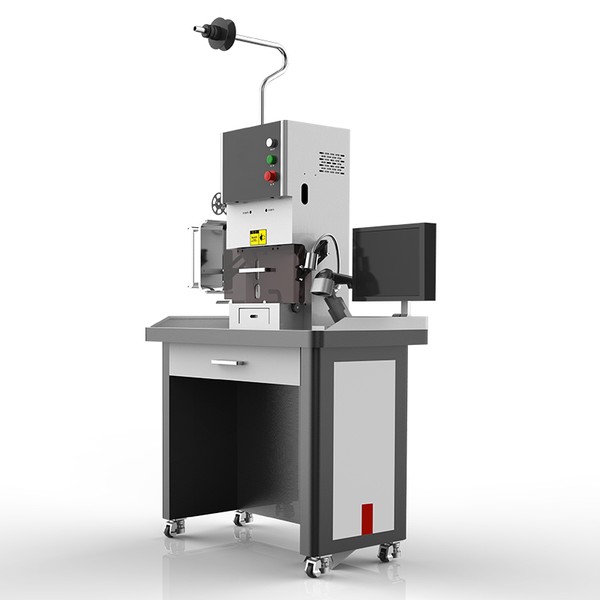
None of this is a compromise if your QC plan is built around crimp-height checks and pull tests. Hundreds of our customers run semi-automatic mute terminal crimping machines exactly this way.
When servo pays for itself
The payback math changes once any of these appear:
1. Defect cost is high. An unmonitored bad crimp that reaches an EV harness is a recall, not a scrap part. 2. The customer asks for data. Automotive and new-energy tier suppliers increasingly require crimp-force documentation per terminal. 3. Volume justifies the capital. A servo press running two shifts replaces the *monitoring labour* (operator gauging and logging) as much as the crimping itself. 4. Force control fixes a real process problem. Stripping through to wire, or crimping onto an empty terminal, shows up as a force-curve deviation the machine rejects — before the part ships.
A practical rule we give buyers: if you can name the financial damage of one undetected bad crimp, compare that number against the price difference of the press. For new-energy and high-voltage harnesses — where terminals run from 6 to 120 mm² and every joint is safety-relevant — the force-monitored servo machine is usually the economical choice, not the luxury one.
What to check before you buy a servo crimping machine
- Real force range. Match the machine tonnage to your largest terminal, not your average one. A 20–40 t machine (our TR-SG20T-40T class) covers large tubular and battery terminals; an 8 t machine suits small open-barrel terminals.
- Force sampling. Ask whether the controller records peak force only or the full curve. Full-curve machines catch seating problems peak-force logging misses.
- Die compatibility. Servo presses still use standard crimp dies. Confirm the die family (OESM-type or brand-specific) before committing.
- Data export. CSV, MES interface or simple USB logs — pick what your QC system can actually consume. See our guide on servo crimping for EV & HV harnesses for the specification checklist.
FAQ
Can a pneumatic press be upgraded to force monitoring? Not to true in-stroke force control. External force sensors add some detection but the air drive still cannot hold a controlled force profile the way a servo drive can.
Do servo presses crimp slower? Cycle time is comparable; the difference is not speed but stroke control. With feeders and terminal reels set up, throughput depends on the whole workstation, not the drive alone.
Is servo worth it for a small job shop? Often not yet. Start with a quality semi-auto or pneumatic machine, build the QC habit, and move to servo when a contract demands data or defect cost starts to hurt.
Bottom line
Buy the drive your *quality system* needs, not the one that matches your budget alone. Pneumatic and semi-auto machines remain the right first machine for most small shops; servo machines earn their premium where every crimp is data and every defect is expensive. Tell us your terminal range and monthly volume — we will recommend the drive and tonnage with a straight answer and a payback sketch.