
New-energy vehicles (EV, PHEV) and high-voltage applications have changed what "good crimping" means. It is no longer enough to crimp with a consistent mechanical stroke — busbars, thick cables and battery interconnects demand force-controlled crimping with process data you can prove. This guide explains what to specify when you buy a servo crimping machine for new-energy work, and where conventional machines fall short.
1. Why servo changes the quality argument
A conventional (mechanical/pneumatic) crimper applies a fixed die stroke. If the wire strand count, terminal hardness or insulation varies slightly, the resulting crimp height drifts — and drift is exactly what EV quality engineers audit.
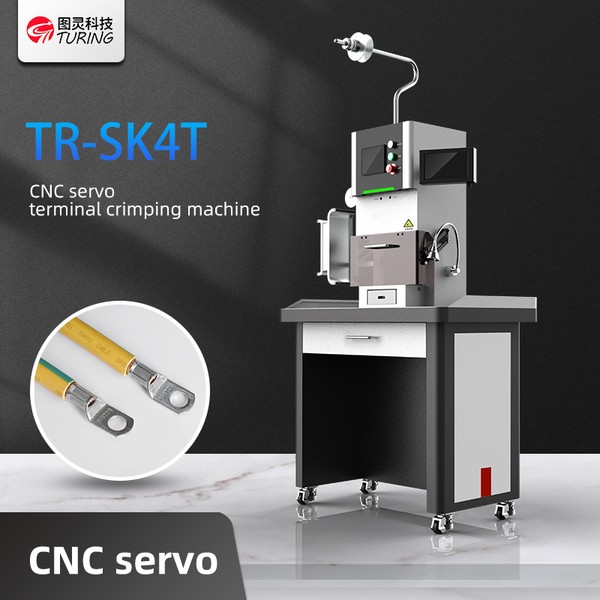
A servo-driven crimper closes the dies with an electric servo motor under closed-loop control. The controller knows force and position through the whole stroke. Benefits that matter for new-energy work:
- Crimp height/force repeatability run after run, shift after shift
- Programmable profiles per terminal type — no mechanical re-tuning
- Force/position data available for process documentation and traceability
- Quiet, energy-efficient operation and fewer wearing parts than pneumatic systems
Our new-energy line is grouped under new energy servo terminal crimping machines, and servo motor terminal crimping variants are listed under servo motor terminal crimp.
2. High-voltage wire brings new constraints
HV harnesses use large cross-section cables (from ~4 mm² up to 95 mm² and beyond in busbar work) with thick insulation. Practical consequences for machine selection:
- Force capacity: large terminals need high crimping force; verify the machine's rated force against your largest terminal
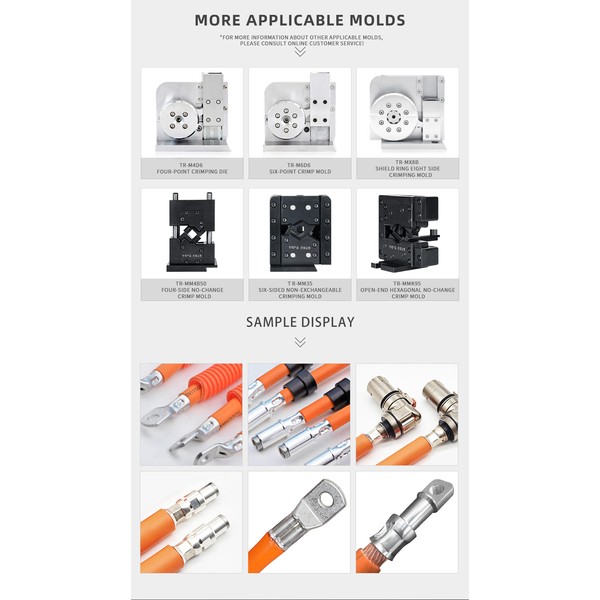
- Die/application tooling: HV terminals often use different die geometry than signal terminals
- Wire handling: big, stiff cables need guided feeding, sufficient strip length control and robust clamping
- Safety isolation: some HV harness steps involve voltage-rated assemblies; keep process separation in mind (this is a layout/procedure question as much as a machine question)
3. What to specify in your RFQ (the checklist)
Send the supplier these points and compare quotations on the same basis:
- Largest conductor cross-section and strand structure (e.g., 50 mm² Class 5 flexible)
- Terminal type and reel/strip format (open-barrel, closed-barrel, aluminum?)
- Required crimp force (kN) at the terminal you will run
- Crimp-height or pull-force acceptance criteria
- Data needs: does your customer require crimp force/position logging per batch?
- Wire length range and whether you need cutting/stripping in the same machine
- Changeover frequency between terminal types
4. Verification before you pay
Numbers on a datasheet are not proof. For new-energy work, ask for:
- A wire sample test: send your actual wire and terminals; request crimp-height and pull-force results
- Force profile demonstration: watch a live crimp curve, not a slide
- Repeatability run: ask for a documented 50–100 piece run with the height distribution
- Service and spare parts commitment: servo systems need competent local support; clarify response time and spare stock
5. Servo vs. the rest of your floor
Servo crimping is not needed for every station. A pragmatic floor layout for an EV or industrial harness shop:
| Station | Recommended class |
|---|---|
| HV battery cables, big terminals, force-critical jobs | Servo crimping machine |
| Standard signal terminals, high volume | Fully automatic terminal crimping (see the TR-HY03-class guide) |
| Short runs, special terminals | Semi-automatic machines |
| Busbar/copper processing | Copper busbar peeling and dedicated processing equipment |
6. Common buying mistakes
- Buying force capacity you never use — every kN of extra force adds cost; match the machine to the largest terminal, with ~20–30% headroom
- Ignoring the applicator/die ecosystem — check that dies for your terminal family are available and reasonably priced
- Forgetting data output — if your customer audits process records, confirm the machine can export crimp data before purchase
- No sample test — for new-energy work this should be a condition of order, not an afterthought
FAQ
Q: Is servo crimping required by automotive quality standards? A: Standards generally require controlled, verifiable crimping processes; servo machines are the common way to demonstrate force control and traceability. Ask your customer's quality team which evidence format they accept.
Q: Can one servo machine handle both small signal terminals and large HV terminals? A: Not usually with the same applicator. Force capacity and die range differ; plan for separate tooling or separate machines unless the supplier can demonstrate a wide working range on your actual terminals.
Q: What power supply do servo machines need? A: Typically three-phase or single-phase depending on size — confirm voltage, phase and installed power against your workshop supply before ordering.