
Every harness shop reaches the same fork in the road: keep crimping on bench presses, move to semi-automatic machines, or invest in a fully automatic line. There is no single "best" answer — there is only the answer that fits your order mix, labor cost and quality requirements. This guide gives you a decision framework, honest comparisons and the payback logic that professional buyers use.
1. Start with the three questions that decide everything
Before comparing brands or quoting models, answer three questions about your production:
- How many terminals per day do you actually run today — and next year? Volume decides whether automation pays for itself.
- How many operators are available and at what cost? Labor saving is usually the largest line item in the payback calculation.
- What is the quality standard of your customer? Automotive and appliance customers audit crimp height, pull force and process records; hobby and general-wiring customers mostly check pull force spot checks.
Write the answers down. They will make every later decision easier — including whether semi-automatic is enough.
2. What the two machine classes actually do differently
Semi-automatic crimping machines
The operator feeds the stripped wire by hand, presses a foot switch or button, and the machine crimps one terminal. The machine positions the terminal (usually from a reel or pre-cut strip), but the operator controls wire placement.
Strengths:
- Lowest entry cost for a given wire range
- Quick changeover between terminal types and dies
- Simple to learn and maintain
- Flexible for short batches and many terminal variants
Limits:
- Output is operator-paced — typically a fraction of an automatic machine
- Crimp quality depends on operator consistency
- One operator runs one station for most of the day
Fully automatic crimping machines
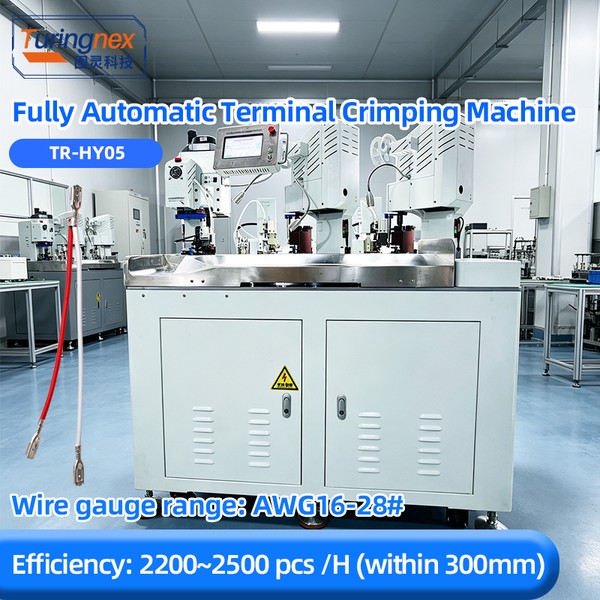
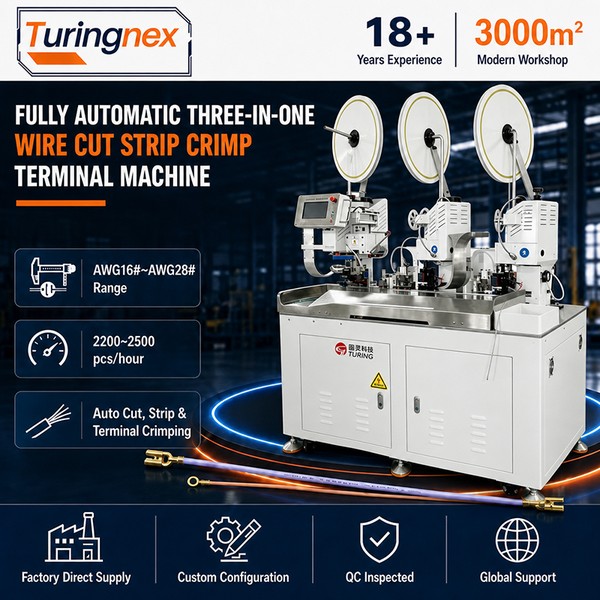
The machine cuts, strips and crimps the wire automatically after the operator loads a coil of wire and selects a program. Examples in our catalogue: fully automatic terminal crimping machines. A machine such as the TR-HY03 class runs at roughly 2,200–2,500 terminals/hour for wires shorter than 300 mm, with servo-controlled feeding and ARM-based motion control — the numbers are documented on the product page, not marketing talk.
Strengths:
- Consistent crimp quality run after run (servo-driven, programmable)
- One operator can supervise multiple machines
- Long-run cost per terminal falls sharply
- Process records become repeatable and auditable
Limits:
- Higher investment and more complex setup
- Changeover between very different wire/terminal combinations takes planning
- Needs stable wire quality and a feeding system matched to the reel
3. A side-by-side comparison table
| Decision factor | Semi-automatic | Fully automatic |
|---|---|---|
| Typical output per operator-day | Low–medium, operator-paced | High, machine-paced |
| Entry investment | Low | Medium–high |
| Labor per 1,000 terminals | High | Low |
| Crimp consistency | Operator-dependent | Program-controlled |
| Setup/changeover speed | Fast | Medium |
| Best batch size | Short–medium, many variants | Medium–long, fewer variants |
| Typical customers served | Repair, low-volume OEM, prototyping | Automotive, appliance, EV, cable assembly |
| Skill level required | Basic | Basic + programming |
4. When semi-automatic is the right answer
Choose semi-automatic machines when:
- Daily output is under a few thousand terminals and growth is uncertain
- Changeovers happen many times per day — short runs with 10+ terminal variants
- Labor is cheap and available, and your customer does not audit process records
- You are prototyping or doing service work where wire lengths and types vary constantly
Semi-automatic does not mean low quality. Semi-automatic mute terminal crimping machines and semi-automatic bulk terminal crimping machines are built for controlled, quiet, repeatable bench work. If your bottleneck is quality consistency at the bench rather than speed, a well-specified semi-automatic machine with a good die and pull-test routine is often enough.
5. When fully automatic pays back
Fully automatic machines earn their keep when:
- Volume is real and growing — calculate payback on current volume, not the sales forecast
- Labor cost is high or operators are hard to find — each automatic machine replaces a share of bench hours
- Customers require repeatable quality — automotive and appliance tiers expect documented process control
- You quote jobs where consistency wins contracts
A simple payback rule used by purchasing teams: divide the price difference between the fully automatic and semi-automatic option by the monthly labor cost you save. If payback is under 18–24 months, the automatic machine is usually the better buy. If it is longer, keep the semi-automatic route and revisit in a year.
6. The middle path that many shops miss
You do not have to buy one class for the whole floor. A common and sensible configuration:
- Fully automatic machines for your 3–5 highest-volume wire/terminal combinations
- Semi-automatic machines for short runs, special terminals and rework
This hybrid keeps average cost per terminal low without forcing every job through a long changeover. Several shops run this way for years before moving a second wire family to full automation.
7. Checklist to take to your supplier
- Wire range: smallest and largest conductor cross-section you will run
- Wire length range: minimum and maximum cut length
- Terminal types: reel-fed or strip-fed? How many variants per month?
- Output target: terminals/hour you need at peak
- Quality requirements: pull-force standard, crimp-height control, records
- Floor space, power supply and air supply available
- Spare dies, spare parts and training included in the quotation
FAQ
Q: Can one operator really run two or three fully automatic machines? A: With servo-driven, programmable machines and stable wire quality, yes — many harness shops run two to three automatic crimping stations per operator for long runs. Keep changeover and wire-jam handling simple or you will lose the benefit.
Q: Is a semi-automatic machine enough for an ISO-audited customer? A: It can be, if you add pull-test records and controlled operator procedures. Some customers, however, specify automatic or semi-automatic equipment with documented settings. Ask your customer what their audit requires before investing.
Q: Do fully automatic machines handle very short wires? A: Yes, but output depends on wire length — short wires take more handling per piece. Check the machine's rated output for your wire length, as in the TR-HY03 class example above (2,200–2,500 pcs/h for wires under 300 mm).