
A V-blade closes on the cable from two sides, so the cut it makes is a wedge. On a single-layer PVC lead that is invisible. On a shielded new-energy cable with a foil wrap, a braid and an inner jacket, the same wedge shows up as a tapered end and a scored shield.
What a V-blade does to a multi-layer cable
Two opposing blades descend until the gap between them matches the depth you dialled in. Because the blades approach from opposite sides, the kerf is widest at the two entry points and narrowest in the middle. On a 30 mm² new-energy cable the sheath is not perfectly round either, so the two blades rarely reach the same depth.
The consequence is a strip end that is not square to the axis. You usually see it as a step at the cut: the shield is exposed on one side of the cable before the other. Downstream, that step is what catches in a ferrule or leaves a sliver of foil behind.
What changes with a ring blade
A ring-blade head spins a circular cutter around the cable rather than pushing two blades in from the sides. The cut follows the circumference, so depth is set once and is uniform all the way around. The end face comes out square, and the shield or foil is cut cleanly instead of being dragged.
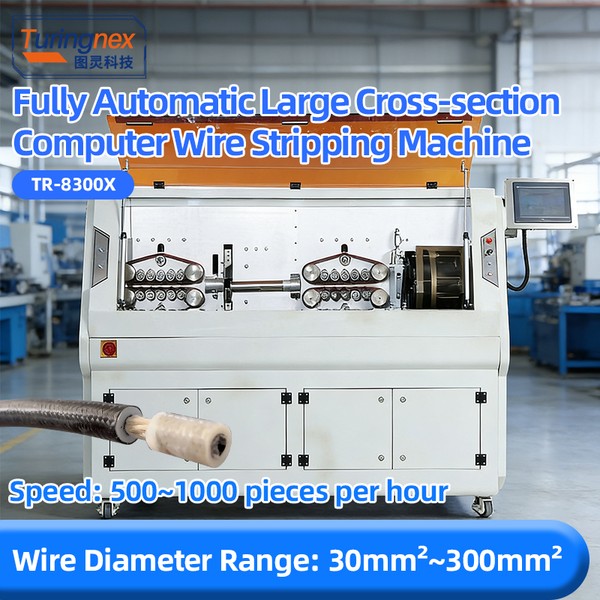
On the TR-8300X large-cross-section computerised wire stripping machine, ring cutting is the head type, and the machine handles 30-300 mm² with a cutting length of 10-99999.99 mm. Cutting tolerance is stated as within 0.002 x L, front-end stripping runs 10-1000 mm, rear-end 10-300 mm, and the maximum permissible cable diameter is Ф15-45 mm.
The same ring-cutting head is used across the smaller large-cross-section models. The TR-8030X covers 1-30 mm² with a maximum permissible diameter of Ф16; front-end full strip 1-190 mm, front-end partial strip 1-1500 mm, rear-end full strip 1-80 mm and rear-end partial strip 1-500 mm.
Ring cutting is not only about neatness
Two other consequences matter in production. First, a ring blade can be set to a shallow depth and run in several passes, which is how inner and outer jackets are stripped without nicking the conductor. Second, because the blade is not being driven into the side of the cable, the clamping force needed to hold it still is lower — useful on soft silicone and high-elasticity wire.
| Parameter | TR-8030X (ring blade) | TR-8300X (ring blade) | TR-8030Z (V-blade, mid-span) |
|---|---|---|---|
| Stripping range | 1-30 mm² | 30-300 mm² | 1-30 mm² |
| Max. permissible diameter | Ф16 | Ф15-45 mm | Ф16 |
| Cutting length | 1-99999.99 mm | 10-99999.99 mm | 1-99999.99 mm |
| Cutting tolerance | Within 0.002 x L | Within 0.002 x L | Within 0.002 x L |
| Front-end stripping | Full 1-190 mm / partial 1-1500 mm | 10-1000 mm | Full 1-200 mm / partial 1-500 mm |
| Rear-end stripping | Full 1-80 mm / partial 1-500 mm | 10-300 mm | Full 1-80 mm / partial 1-500 mm |
| Mid-span stripping | Not specified | Not specified | Multi-section, up to 32 sections |
Which head to specify
If the cable has one jacket and the conductoryou cut never sits closer than about 0.5 mm to the blade, a V-blade machine is cheaper and faster to set. Specify ring cutting when any of these is true:
- The cable has two or more layers that must be opened in separate passes.
- The layer under the jacket is a foil, a braid or a drain wire that must not be scored.
- The strip end is inspected, or has to enter a ferrule or a seal without a step.
- The conductor is soft or stranded and a nip marks it.
What to send when you ask for a quote
For a ring-cutting machine the useful answers are: total cross-section, number of layers and what each layer is, jacket material and wall thickness, the strip length at each end, and whether any mid-span window is needed. Sample cable settles the rest.