
Mica tape, ceramic tape and acetate cloth tape are supplied with a release-paper backing that keeps the adhesive clean until the moment of application. On a plain tape head that backing becomes a problem: it has to be stripped at the same rate the tape is consumed, and it has to go somewhere. Left unmanaged it tears, feeds unevenly, or wraps itself into the finished harness.
Why liner handling is a mechanism, not an accessory
The liner cannot simply be pulled off at a constant speed. As the supply roll empties, its diameter falls, and for a given motor speed the linear speed of the paper drops with it. If the rewinder turns at a fixed rate, the liner tension rises as the roll shrinks — it stretches and snaps, or drags the tape off line. What is needed is dynamic tension feedback: the rewinding torque is adjusted as the roll diameter changes, so the peel force stays constant from a full roll to an empty core.
A dedicated waste spool then collects the peeled paper without interrupting the cycle. On a machine built this way, the operator loads the taped workpiece and the liner is handled in step with the wrap rather than by hand.
The machine built for this: TR-303XH-1
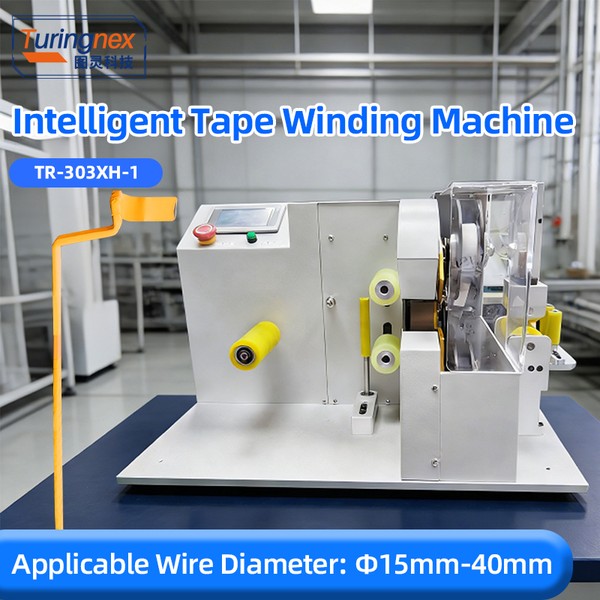
The TR-303XH-1 intelligent tape winding machine with paper take-up and straightening unit combines three functions in one unit: tape wrapping, synchronous automatic separation and rewinding of the release paper, and workpiece straightening. The straightening stage matters on flat and thick conductors, where the wrapping tension and the weight of the workpiece can introduce a twist or a bend that has to be taken out before the part goes on.
| Parameter | TR-303XH-1 | TR-303XH (raised frame) |
|---|---|---|
| Primary purpose | Release-paper-backed tape; flat or thick conductors | Large-diameter harnesses |
| Workpiece | With release paper Ф15-40 mm; with the middle platform fitted, Ф3-40 mm | Ф3-40 mm, especially Ф25-40 mm |
| Flat conductor | Thickness 1-10 mm, width 10-30 mm | — |
| Tape width | 9-30 mm | 9-30 mm |
| Tape outer diameter | ≤140 mm | Under 170 mm wraps Ф3-30 mm; under 140 mm wraps Ф3-40 mm |
| Tape bore | Ф38 (optional Ф32, Ф76) | Ф76 or Ф38 (normally supplied with Ф76) |
| Speed | 4,500 rpm, adjustable | 4,500 rpm, adjustable |
| Wrap modes | Full wrap, interval wrap, spot wrap; adjustable overlap | Full wrap, interval wrap, spot wrap; adjustable overlap |
| Power | AC 220V / DC 24V 50/60 Hz (110 V optional) | AC 220V / DC 24V 50/60 Hz (110 V optional) |
| Size and weight | 630×565×410 mm, 63 kg | 535×550×390 mm, 56 kg |
Why the wire-diameter figure comes with a condition
The TR-303XH-1 is quoted as Ф15-40 mm for workpieces that carry release paper, and Ф3-40 mm once the middle platform is fitted. The reason is physical rather than commercial: the paper take-up and straightening unit occupies space directly beside the winding axis, so the minimum diameter it can wrap is set by the clearance around that hardware. Removing or adding the platform changes the clearance. If your work spans both thin and thick wire on the same machine, tell us the range up front — that decides whether one machine covers it or whether the platform has to be reconfigured between jobs.
Matching the tape system to the job
- Copper and aluminium busbars for new energy vehicles: flat, thick and easily deformed. Specify the straightening function, not just the peeler.
- Mica and ceramic tape: the backing is not optional, so plan the waste path and the spool capacity for the volume you run.
- Acetate cloth and PVC: both run on the same head, so the same machine can cover an insulation class change without a second machine.
- Harnesses that need only support, not thermal class: a standard spiral head may be enough. The TR-303XH intelligent tape winding machine covers large diameters without the paper-handling unit, and costs less to run and maintain.
What to check before ordering
- Which of your tapes carry release paper, and what is the backing weight and width?
- What is the shortest and longest workpiece diameter the machine must handle?
- How much liner is generated per shift, and does the waste spool cover a full shift without stopping?
- Does the workpiece need straightening before winding, or only support?
- Is a 110 V supply required, and does the machine need to integrate with an existing line?
Tell us the tape specification and the workpiece drawing, and we will confirm the platform configuration and liner handling you need.