
"Protector welding" covers three different parts that are welded differently: NTC temperature sensors, thermal protectors and thermostats — each with its own lead style, process chain and quality expectation. Choosing a welding machine starts with identifying which of the three families your part belongs to, then matching volume and customisation needs. This guide positions the three machines in our Protector Welding Machine category — TR-GY01, TR-WK02 and TR-WK01 — and explains the selection logic behind each.
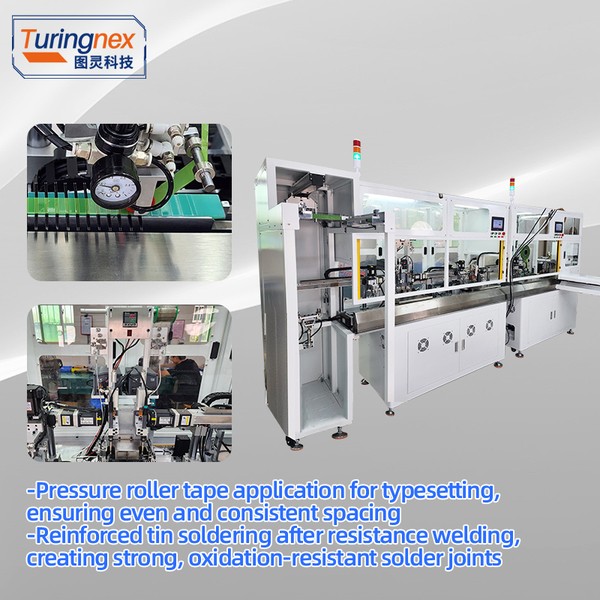
NTC typesetting & welding machine
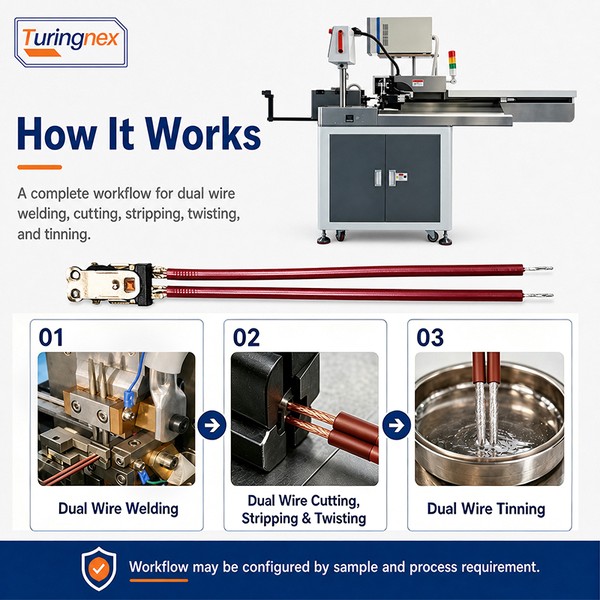
Thermal protector welder, dual-mode (850/700 pcs/h)
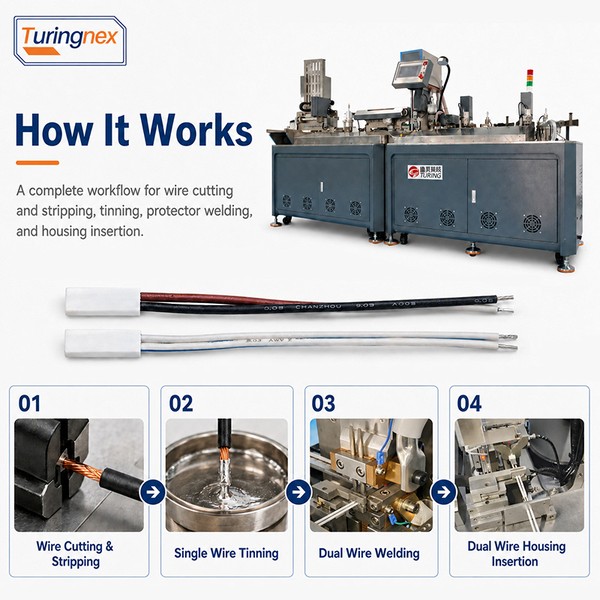
Thermostat welding + housing insertion
Know the part first: three families, three process chains
| Part family | Typical chain | Typical buyer |
|---|---|---|
| NTC temperature sensor | Arrange/weld the resistor element, cut and strip leads, tin ends | Appliance, HVAC and battery-temperature sensing lines |
| Thermal protector | Weld leads to the protector body, with or without tin dipping | Protector manufacturers serving appliances and motors |
| Thermostat with housing | Weld and then insert the welded part into a plastic housing | Thermostat subassembly lines |
The chain decides the machine — which is why we build three dedicated machines rather than one "universal welder".
TR-GY01 — the NTC arranging-and-welding machine
The TR-GY01 NTC resistance typesetting and welding machine automates the front of the NTC chain: wire cutting, stripping, terminal crimping, tin dipping and the typesetting of the NTC resistor into the welding position, on a single-phase 220 V supply with 0.5-0.7 MPa compressed air.
Why it fits NTC work: NTC leads are short, mixed and need precise element positioning before welding. Typesetting automation removes the manual alignment that causes most NTC weld rejects. If your line builds temperature-sensing assemblies with NTC elements, GY01 is the machine that turns the alignment step into a machine function.
TR-WK02 — the thermal protector welder with dual-mode output
The TR-WK02 fully automatic thermal protector welding machine is built for protector leads at volume. It welds thermal protectors in two modes on one machine — non-tinning up to 850 pcs/h and tin-dipping up to 700 pcs/h — over a wire range of AWG16#-26# including 0.8 mm and 1.0 mm bare copper. The welding station runs from an inverter power supply (main machine 220 V, inverter 380 V) for stable low-energy welding on fine wire; the machine footprint is L2400 x W850 x H1600 mm.
Why it fits protector work: protector customers ship tinned and non-tinned versions to different downstream processes. Dual-mode output lets one machine quote both — the same flexibility that matters when a protector maker's order book mixes solder-joint and crimp-joint customers.
TR-WK01 — thermostat welding with housing insertion
The TR-WK01 automatic thermostat welding and housing-inserting machine covers the thermostat family, where welding is only half the job: the welded thermostat must then be inserted into its plastic housing. TR-WK01 combines the welding process with housing insertion under PLC / touch-screen control, closing the step where manual housing assembly typically introduces rejects.
Why it fits thermostat work: if your drawing ends with "welded part inside housing", the machine that does both in one flow removes a whole handling step — and the misalignment and contamination that come with it.
Choosing between them
| Your part | Machine | Key technical points |
|---|---|---|
| NTC sensor elements, mixed short leads | TR-GY01 | Cut, strip, crimp, tin-dip, typeset in one flow; 220 V single phase, air 0.5-0.7 MPa |
| Thermal protectors, volume, tinned/plain mixed | TR-WK02 | Dual mode 850/700 pcs/h; AWG16#-26# (0.8/1.0 mm); inverter welding supply |
| Thermostat + housing insertion | TR-WK01 | Weld and insert housing in one automatic sequence; PLC / touch-screen |
Ask three questions before choosing: (1) which part family does the line run? (2) does the output need tinning, housing insertion or both? (3) how much of your process is non-standard?
Why customisation is the real differentiator
Protector and thermostat parts are rarely "standard". Housings differ by brand, leads by length, welding positions by element geometry — which is why the machines above are only the starting point of a protector welding solution. What we bring as a non-standard protector welding machine builder is process engineering around your sample:
- Sample-based configuration. Send the actual protector or thermostat and its housing; we engineer the welding position, dies and feeding to the part rather than asking the part to fit a stock machine.
- Process customisation. Tinning or non-tinning, housing types, lead lengths and output targets are configured per line, not selected from a brochure.
- One responsible partner. Machine, tooling and process know-how from one engineering team means the line is commissioned against your part, with sample runs before shipment.
This is the difference between buying "a protector welder" and getting a protector welding solution — and it is the area where a specialist builder earns its keep.
The trend: protector welding is moving toward integration and fine-wire control
Three industry trends make the machine choice more strategic than it used to be:
1. Integration across the chain. Welding alone is no longer enough — customers want typesetting (GY01), dual-mode dipping (WK02) and housing insertion (WK01) inside the machine flow, because every external handling step is where small parts get lost or misaligned. 2. Fine-wire welding stability. Protectors keep shrinking, so leads run down to 0.8-1.0 mm bare copper. Stable low-energy welding (inverter supply) and documented settings are becoming the baseline for appliance and EV-adjacent audits. 3. Customisation at volume. High-volume lines still run non-standard parts; the winning suppliers deliver machine + tooling engineered per sample, with the output data their customers require. See our trend analysis on thermal protector welding for the deeper picture.
FAQ
Can one machine weld NTC sensors, protectors and thermostats? Physically yes, economically no — the chains differ (typesetting vs dual-mode dipping vs housing insertion). Match the machine to your dominant part family, and keep the second family as a separate station.
Do you build machines for non-standard housings? Yes — non-standard protector welding is our focus. Send the housing drawing or sample and we will engineer the tooling; see the product pages for standard ranges, then confirm custom options with our engineers.
What wire sizes do these machines cover? TR-WK02 handles AWG16#-26# including 0.8/1.0 mm bare copper; TR-GY01 processes wire cutting, stripping, crimping, tin-dipping and typesetting within its rated range (confirm against your lead specs on the product page).
Bottom line
Choose the protector welding machine by part family first — NTC (TR-GY01), thermal protector with dual-mode output (TR-WK02), or thermostat with housing insertion (TR-WK01) — then by volume and by how much of your process is non-standard. Where the part is non-standard, buy the engineering: send us your protector or thermostat sample and target output, and we will configure the machine, tooling and process around it — with sample runs before you commit.