
The heat-shrink bake is a short, unglamorous step that quietly decides whether a harness passes final inspection. When only the terminal needs shrinking but the harness is two or three metres long, a conventional closed oven becomes the bottleneck: the cable body has to go somewhere, and dragging it through the chamber risks a scorched jacket and a distorted sleeve.
The problem with a closed chamber on a long harness
An enclosed oven does its best work on short parts and small assemblies: the chamber holds temperature evenly, the insulated walls keep the heat in, and a mesh belt carries the part through in a controlled time. Feed a 2.5 m harness into it and the geometry works against you. Only a short section can be inside the heating zone at any moment, the rest of the cable has to be supported or it drags, and every extra metre increases the chance that the jacket picks up a mark or the sleeve shifts before it has shrunk.
Two failure modes follow. The first is uneven shrink, because the terminal was only partially inside the zone. The second is cosmetic damage to a cable body that has nothing to do with the joint being baked.
What open-type feeding changes
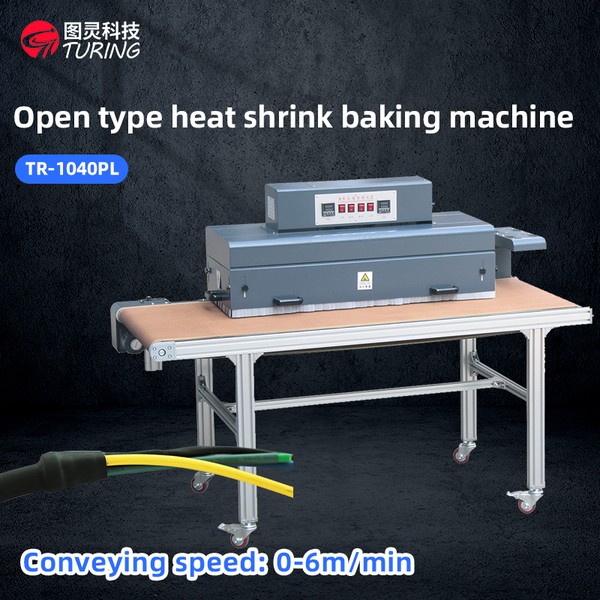
An open-type oven is built so the workpiece can extend outside the machine body. The heating zone is open at the feed and exit ends, and the cable body hangs or rests outside the chamber on adjustable rails while only the terminal head passes through the tunnel. The long part of the harness never enters the heated region, so it cannot scorch, and the joint still receives the full, controlled bake.
The same structure makes the oven easier to link into a line: because the workpiece is not enclosed, the machine can be positioned at the end of a cut-and-strip or crimping station rather than requiring the part to be loaded into a cabinet.
TR-1040PL: the floor-standing open type
The TR-1040PL open-type heat-shrink baking oven is the floor-standing reference of this family. The chamber measures 1,600 × 700 × 1,200 mm with a heating zone of 1,000 × 360 × 100 mm, and it runs on a high-temperature PTFE mesh belt at 0-6 m/min. Temperature is held by two controllers in a double-sided heating arrangement across 0-260 °C, and the conveying load rating is 20 kg.
Where a wider mouth is needed — for wider assemblies, fixtures or multi-core bundles — the same open-type platform is available in wider versions at 900 mm and 1,200 mm widths.
Comparing the two families
| Parameter | TR-1040PL open type (floor-standing) | TR-848PL enclosed (floor-standing) | TR-1248PL enclosed (floor-standing) |
|---|---|---|---|
| Access | Open feed and exit; workpiece ends extend outside the body | Fully enclosed cabinet | Fully enclosed cabinet |
| Machine size | 1,600×700×1,200 mm | 1,600×480×1,200 mm | 2,000×480×1,200 mm |
| Heating zone | 1,000×360×100 mm | 800×400×150 mm | 1,200×400×150 mm |
| Rated power | 7.2 kW (4.0 kW optional) | 6 kW (3.6 kW optional) | 9 kW |
| Temperature | 0-260 °C, two controllers, double-sided | 0-260 °C, two controllers, double-sided | 0-260 °C, two controllers, double-sided |
| Conveyor | High-temperature PTFE mesh belt | High-temperature PTFE mesh belt | High-temperature PTFE mesh belt |
| Speed and load | 0-6 m/min; 20 kg | 0-6 m/min; 20 kg | 0-6 m/min; 20 kg |
| Net weight | 85 kg | 65 kg | 75 kg |
Both families are available in a 110 V or 380 V configuration for export markets, and the standard factory lead time for these models is 5-7 working days.
What the enclosed design is genuinely better at
The enclosed cabinet is not simply the cheaper option; on the right part it is the better one. Its double-layer heating chamber is lined with 1,200 °C high-temperature insulation cotton, so the outer surface stays cool to the touch and the chamber holds an even temperature with less energy. For short leads, batch-tray work and small assemblies, that combination of thermal stability and low surface temperature is exactly what a workshop wants — and it removes a burn risk that open ovens require guarding against.
Other families worth knowing about before you specify
- Desktop open type: the same open-feed principle in a bench size, for smaller parts and limited floor space.
- Suspended type: the heating tunnel is carried above the work, useful where the part is best supported from above.
- Crawler type: upper and lower synchronised high-temperature silicone belts grip the part from both sides — the answer when a flat part will not track reliably on a mesh belt.
- All-electric, no air supply: a desktop hot-air unit for workshops with no compressor. It needs no external air line, reaches 0-450 °C with digital control, and costs a fraction of a tunnel oven — but it is an operator-fed unit, not a production line.
How to specify an oven in five questions
- What are the workpiece dimensions, and how much of it may enter the heating zone?
- What heating zone length and width does the joint actually need?
- What is the target temperature, and does the sleeve call for double-sided heating?
- Which voltage system is available on site — 220 V single phase, 380 V three phase, or 110 V?
- What throughput is required, so belt speed and zone length can be matched to the cycle?
Send us the joint drawing and the sleeve specification, and we will confirm whether an open-type or an enclosed oven is the right starting point.