
Mid-span stripping opens the jacket at points along the cable instead of only at the two ends. On a harness that is taped or clipped at intervals, that is what lets tape be applied to bare conductor rather than over insulation.
Two kinds of window
There is a practical difference between windows that repeat and windows that do not.
- Regular windows. Every window has the same length and the same spacing. Once the machine is set, the run is deterministic and there is no practical limit on how many windows appear along the cable.
- Irregular windows. Different lengths, different spacings. The machine still does it, but each window is a separate entry in the program, and the practical ceiling is the controller's program size.
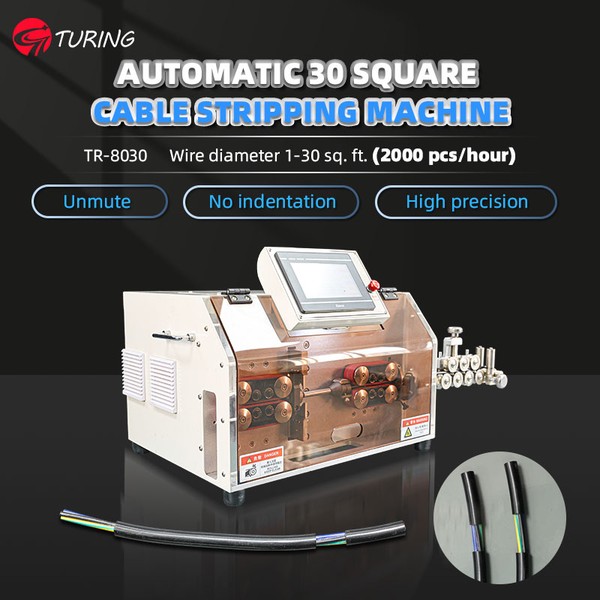
The TR-8030 family documents multi-section mid-span stripping with any interval and any mid-span length up to 32 sections when the sections differ, and no stated limit when the interval and the window length are identical across sections. That is the figure to quote to a customer who asks 'how many can you do' — the honest answer depends on which of the two cases applies.
The cutting-length ceiling
Large-cross-section machines quote a maximum cutting length in the 1-99999.99 mm range, which is 99.99 m. In practice the limit you hit first is not the counter but the floor: a 99 m cut needs somewhere to lay 99 m of 240 mm² cable without dragging it across itself. If the finished lead is longer than about 20 m, the pay-off and take-up arrangement usually decides the layout.
Where the tolerance comes from
Cutting tolerance is quoted relative to length — within 0.002 x L, where L is the cutting length. Used properly, that means a 500 mm lead has roughly ±1 mm and a 5,000 mm lead roughly ±10 mm. It is a proportional figure, so it is worth writing it that way in a purchase specification instead of quoting a single millimetre value.
| Feature | TR-8030 (base) | TR-8030Z (mid-span device) | TR-8030Y (all-in-one) |
|---|---|---|---|
| Stripping range | 1-30 mm² | 1-30 mm² | 1-30 mm² |
| Mid-span stripping | Not specified | Up to 32 sections (unlimited when identical) | Not specified |
| Front-end stripping | Full 1-200 mm / partial 1-500 mm | Full 1-200 mm / partial 1-500 mm | Full 1-200 mm / partial 1-500 mm |
| Rear-end stripping | Full 1-80 mm / partial 1-500 mm | Full 1-80 mm / partial 1-500 mm | Full 1-80 mm / partial 1-500 mm |
| Max. permissible diameter | Ф16 | Ф16 | Ф16 |
| Machine size / weight | 845 x 540 x 625 mm | 845 x 540 x 625 mm, 96 kg | 845 x 540 x 625 mm |
| Optional add-ons | — | Mid-span stripping device | Pay-off machine or take-up machine |
The all-in-one question
The TR-8030Y is the same stripping platform arranged as an all-in-one that can take an optional pay-off machine or take-up machine. The trade-off is floor space against handling. A stand-alone stripper with a separate de-reeler needs an operator to feed and collect; an all-in-one does not, but it takes more floor and cannot be moved between jobs as easily.
Where the harness has a regular repeat and long cut lengths, the all-in-one usually wins on handling time. Where the shop runs many short jobs across several machines, keeping the stripper separate is more flexible.
What to put in the specification
List the windows, not the feature. For each window give the distance from the reference end, the window length, and whether the interval repeats. Add the jacket and core materials, the cross-section, and the two end-strip lengths. If the windows repeat, say so — it changes the machine configuration and the price.