
Battery cables, welding leads, busbar feeders and automotive power cables all use large cross-section conductors — roughly 10 to 120 mm². Processing them looks like normal stripping, but it behaves differently: the wire is stiff, the insulation is thick, and a machine that handles 1 mm² perfectly will jam, nick or stall on 95 mm². This guide explains the real requirements of big-wire processing and how to verify a machine actually meets them.
1. Why large wire is a different problem
Three physical realities separate large-wire processing from small-wire work:
- Stiffness: thick conductors resist feeding and bending; the machine needs robust clamping and straight-through guidance
- Thick insulation: blades must cut deeply and cleanly without nicking strands — blade depth control becomes critical
- Length and weight: cut lengths get long and heavy; the machine and take-up system must handle coiling or stacking without kinking
Machines that ignore these realities show up as: nicked conductors, crushed insulation, jammed feeders and endless operator babysitting.
2. What the working range really means
A specification like "10–120 mm²" is only meaningful with the details behind it:
- Conductor class: solid, stranded, or fine-stranded (Class 5/6 flexible) — flexible wire behaves differently under blade pressure
- Insulation type and thickness: XLPE, PVC, rubber and silicone differ in cut behavior
- Strip length: front and tail strip ranges (some machines strip both ends in one cycle)
- Cut length range: from short jumpers to full cable lengths
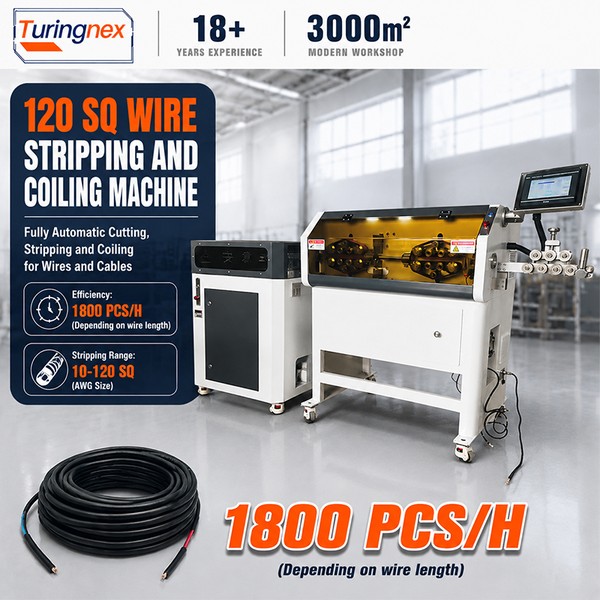
For example, the TR-8120 class (automatic wire stripping and coiling machine) documents a working range of 10–120 mm² (AWG 8–0000), front strip 1–800 mm, tail strip 1–400 mm, and cut length up to 99,999 mm — those are the kind of concrete figures you should request for every candidate machine. If the supplier only quotes "large wire," ask for the table.
3. Blade and nick protection
Nick detection is the difference between a professional big-wire machine and a cheap one:
- Servo blade depth with programmable settings per wire type
- Strand-safe stripping: blades that stop short of the conductor or use V-blades matched to conductor class
- Nick check on flexible wire: fine-stranded (Class 5) wire is easily damaged; request a sample test with YOUR wire
Ask the supplier to strip a sample of your actual cable and inspect the result under magnification — that is the only reliable proof.
4. Coiling, stacking and take-up
A 30 m cable at 120 mm² does not drop into a tray. Big-wire machines need a take-up strategy:
- Coiling for long lengths (coil diameter must not exceed the cable's minimum bend radius)
- Length counting for cut-to-length accuracy
- Stacking/straightening for rigid conductors that resist coiling
If your product is coiled cable, verify the machine's coil handling; if you feed downstream processes (crimping, connector assembly), verify straight output and length tolerance.
5. Choosing between stripping-only and stripping-and-coiling machines
| Need | Recommended class |
|---|---|
| Cut + strip both ends, high volume | Automatic strip & cut machine with dual-end strip |
| Cut + strip + coil long lengths | Stripping & coiling machine (TR-8120 class) |
| Strip only (wire already cut) | Semi-automatic or bench stripper |
| Busbar / flat copper | Dedicated copper busbar peeling machine |
Pair this with the rest of your floor: after stripping, big wire usually goes to heavy crimping or connector assembly. Confirm the machine's output length/straightness matches your downstream feeder.
6. RFQ checklist
- Conductor cross-section range and class (stranding)
- Insulation material, thickness and hardness
- Strip lengths: front, tail, both ends?
- Cut length range and tolerance
- Output format: coiled, stacked, or straight-to-downstream
- Blade set: how many sizes/types included; cost of spares
- Sample test: your actual cable, your acceptance criteria
7. Pitfalls to avoid
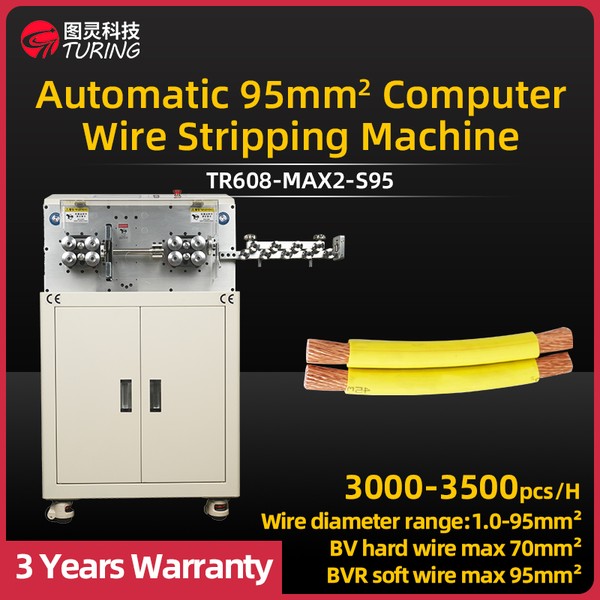
- Judging by the smallest wire — a machine rated "10–120 mm²" may process 10 mm² beautifully and struggle at 95 mm²; test at your largest size
- Ignoring flexible wire — Class 5/6 conductors need gentle stripping; blade depth is everything
- Forgetting coil handling — the cheapest machine quote without take-up is not a quote for your process
- No sample test clause — make the test with your cable a condition of the order
FAQ
Q: Can a standard small-wire stripper handle 35 mm² occasionally? A: Not reliably. Large-wire machines have the clamping force, blade travel and guidance that occasional big jobs need. Overloading a small machine risks jams and nicked wire — and downtime.
Q: What does "strip both ends" cost in cycle time? A: Dual-end stripping roughly doubles strip time per piece versus single-end. Request cycle times for your specific strip lengths.
Q: Is coiling automatic on these machines? A: On stripping-and-coiling machines (TR-8120 class) yes, coiling is integrated. On strip-and-cut machines, output may be straight pieces requiring separate handling. Choose per your end product.