
A sheathed cable has to be opened twice: once through the outer jacket, once through the inner. Doing it as two separate passes on two machines doubles the handling and adds a second chance to mark the conductor.
Why two passes is the default
The outer jacket is thick and irregular; the inner jacket sits directly on the conductor. A single blade depth that opens the outer jacket will mark or sever whatever is underneath. So the usual answer is two machines, or two setups on one machine: strip the outer jacket over a length, then re-clamp and strip the inner.
The cost is not the second cut, it is the second setup. Every re-clamp is an opportunity for the lead to sit at a slightly different angle, which shows up as a variation in the inner strip length.
What makes one pass possible
Three things have to be true. The blade has to reach the outer jacket without following it into the inner layer, the machine has to know where the outer jacket ends, and the cable has to be held so that it does not rotate between the two operations. On machines in this class the first is handled by a shallow, repeated scoring pass rather than one deep cut; the second by measuring from the reference end; the third by clamping before the blade advances.
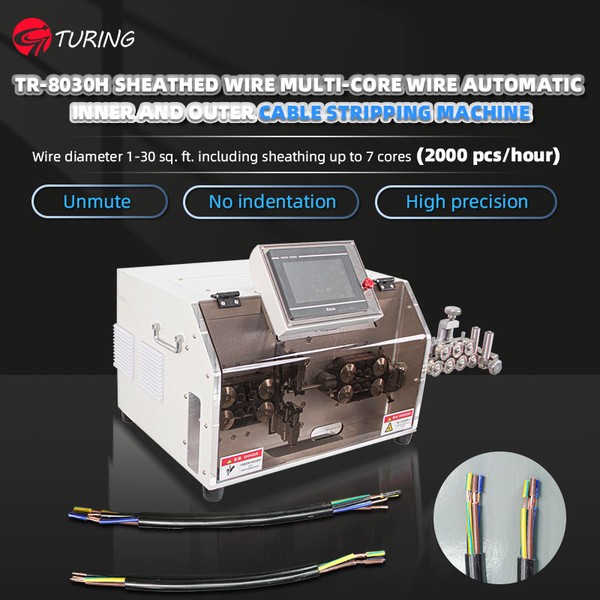
The TR-8030H is the inner-and-outer jacket stripping machine in the large-cross-section range, covering 1-30 mm². The company's own description of the range is 'outer jacket + core wire, fully automatic cutting and stripping'. The same capability appears at the small end on the TR-8010H (1-10 mm² sheathed wire) and at the large end on the TR-8120H (10-120 mm²).
When the manipulator and twisting options matter
Two variants extend the same platform. The TR-8030HYJN adds a manipulator and a wire-twisting function, which is useful when the stripped cores are twisted before they leave the station. The manipulator also arranges and stacks the finished leads after take-up, which removes a manual handling step on long runs.
| Model | Range | Jacket handling | Extra functions |
|---|---|---|---|
| TR-8030 | 1-30 mm² | Outer jacket only | — |
| TR-8030H | 1-30 mm² | Inner and outer jacket | — |
| TR-8030HYJN | 1-30 mm² | Inner and outer jacket | Manipulator + wire twisting |
| TR-8120 | 10-120 mm² | Outer jacket only | — |
The tolerance you should expect
Cutting tolerance across this range is quoted as within 0.002 x L, where L is the cutting length. Strip lengths are quoted per end and per pass — for example a front-end full strip of 1-200 mm with a partial strip of 1-500 mm available on the same end. When a lead needs both a full strip at the tip and a window further back, those are two entries, not one.
Sample cable is the deciding input
Whether one pass is possible depends on the gap between the outer and inner jacket and on how much the outer jacket moves when it is scored. Neither number appears on a data sheet. Send about two metres of the actual cable and the answer comes back as a confirmed strip length rather than a range.