
When the part gets heavy — a copper busbar, a battery-pack conductor, a thick-walled dual-wall sleeve — the question buyers ask first is usually about oven length. Length is rarely the constraint. The constraint is what carries the part, how many independently controlled heating zones the chamber has, and whether the site can supply three-phase power.
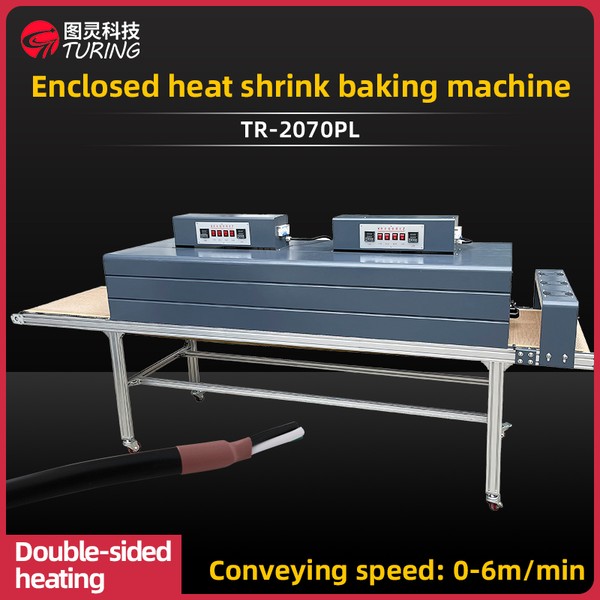
Load rating follows the conveyor, not the chamber
A standard PTFE mesh belt is rated at 20 kg on most of this range, and 10 kg on the smaller desktop chambers. That is enough for any harness and for most small assemblies. Put a solid copper busbar on it and the belt sags between its support rollers, tracks off centre, and eventually contacts the heating elements.
What changes the rating is the conveyor design. A heavy-duty high-temperature stainless-steel chain conveyor is rated at 100 kg — five times the mesh-belt figure — because the load is carried by chain links running in guides rather than by a flexible belt in tension. That is a different machine, not a longer one.
The practical consequence is easy to miss when comparing quotations by chamber size. A 3 m enclosed oven on a mesh belt is still a 20 kg machine; a 2 m chain-conveyor oven is a 100 kg machine. Match the rating to the workpiece first, then choose the length you need.
Why heavy parts need more than one temperature zone
A thick-wall dual-wall sleeve and a solid conductor behind it absorb heat differently from a thin insulating sleeve on stranded wire. The sleeve has to reach its shrink temperature all the way through the wall before the adhesive liner flows, while the conductor acts as a heat sink pulling energy out of the joint. A single control loop with one thermocouple cannot respond to that: it holds one set point while the part experiences a gradient.
Multi-zone control solves it by dividing the chamber into independently controlled groups. The chain-type busbar ovens run 0-300 °C with two groups and four sets of temperature control on the shorter models, rising to three groups and six sets on the longest — which lets the entry zone, the soak zone and the exit zone be trimmed separately so the part sees a controlled profile rather than one flat temperature.
The heavy-part options in this range
| Parameter | TR-1670NH | TR-2070NH | TR-3070NH | TR-2070PL |
|---|---|---|---|---|
| Family | Chain type, for copper busbars | Chain type, for copper busbars | Chain type, for copper busbars | Enclosed, floor-standing |
| Machine size | 2,000×700×1,250 mm | 3,000×700×1,250 mm | 4,000×700×1,250 mm | 3,000×700×1,250 mm |
| Heating zone | 1,600×620×200 mm | 2,000×620×200 mm | 3,000×620×200 mm | 2,000×620×200 mm |
| Conveyor and load | Stainless chain; 100 kg | Stainless chain; 100 kg | Stainless chain; 100 kg | PTFE mesh belt; 20 kg |
| Temperature control | 0-300 °C; two groups, four sets | 0-300 °C; two groups, four sets | 0-300 °C; three groups, six sets | 0-260 °C; two controllers |
| Rated power | 22 kW | 22 kW | 33 kW | 20 kW |
| Power supply | AC 380 V 50 Hz, three phase five wire | AC 380 V 50 Hz, three phase five wire | AC 380 V 50 Hz, three phase five wire | AC 380 V 50 Hz, three phase five wire |
| Belt speed | 0-6 m/min | 0-6 m/min | 0-6 m/min | 0-6 m/min |
| Net weight | 200 kg | 350 kg | 550 kg | 160 kg |
Note the last column carefully. The TR-2070PL is the same chamber length as the TR-2070NH and runs at a comparable power level, but on a mesh belt its conveying load is 20 kg rather than 100 kg. Length and power tell you about throughput; only the conveyor and load rating tell you whether a heavy busbar can be placed on it at all.
Check the power supply before anything else
Every machine in the heavy-part group runs on AC 380 V 50 Hz three-phase five-wire. That is an industrial supply, and it is the one item on the specification that cannot be solved with an accessory. If the site only has 220 V single phase available, the heavy chain-type ovens are not installable regardless of budget, and the realistic route is either a supply upgrade or a smaller part transferred to a mesh-belt chamber.
When three-phase is not the right answer
- Harnesses and small assemblies: a 220 V single-phase mesh-belt oven heats them perfectly well. Three-phase buys nothing here.
- Intermittent heavy parts: if heavy busbars are a small share of output, running them through a standard oven in a fixture may be more sensible than dedicating floor space to a chain machine.
- No compressed air or limited power: desktop all-electric hot-air units need neither an air line nor three-phase, and cover small parts and short lengths.
Lead time and logistics for heavy machines
The chain-type busbar ovens carry a longer standard lead time than the rest of the range — 10-15 working days against 5-7 for the mesh-belt ovens — and they ship in heavy-duty palletised wooden crates. At up to 550 kg net for the longest model, plan the unloading equipment and the final floor position before delivery rather than on the day.
What to include in an enquiry
- The busbar or workpiece drawing, with dimensions and weight per piece.
- The sleeve specification and its required shrink temperature.
- Cycle time and pieces per shift, so belt speed and zone length can be matched.
- The available power supply on site, and whether compressed air is present.
- Whether the oven is a standalone station or feeds an existing line.