
Heat-shrink tubing protects crimped connections from moisture, vibration and short circuits — which is why automotive, appliance and cable harnesses specify it so often. But every piece of tube has to be cut, slipped over the connection, positioned, and shrunk by heat. Done manually, this is slow and inconsistent: tubes wander off the crimp, shrink unevenly, or get scorched. The machine question is not "do we need a heat-shrink machine" but "how much of the process should be automated, and how?"
1. The two process halves
Heat-shrink work splits into two stages that can be automated separately or together:
- Insertion: slip a pre-cut tube over the crimped area (sometimes over a connector/terminal, sometimes over a splice). Orientation and depth matter — the tube must cover the crimp and seal zone.
- Baking/shrinking: apply controlled heat so the tube shrinks evenly without scorching the insulation or melting nearby components.
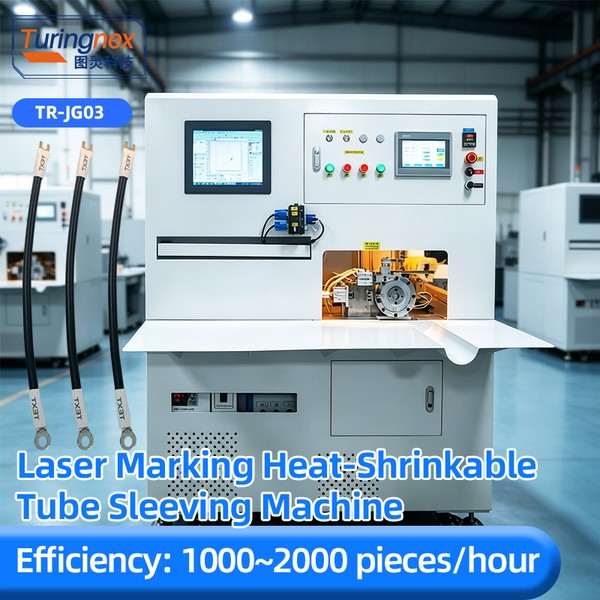
Our catalogue covers both: inserting heat shrink tube baking machines automate the full sequence, while heat shrink baking machines handle the shrink stage for pre-inserted parts.
2. Where the bottleneck usually hides
Shops often measure stripping and crimping carefully but treat heat-shrink as "unskilled work." That is exactly where the cost hides:
- Manual insertion is fine at low volumes, but at a few thousand pieces/day it needs dedicated staff
- Heat guns vary with the operator: too hot scorches, too slow over-shrinks, too little leaves loose tubing
- Positioning errors show up later as IP-test failures or field returns
If your shrink-wrapped connections are growing in volume, time the manual step for one day: pieces per hour per operator tells you whether automation pays.
3. Machine classes compared
| Machine class | What it does | Best for |
|---|---|---|
| Standalone baking machine | Heat-shrinks pre-inserted assemblies in a controlled tunnel/oven | Medium volume, existing manual insertion, many tube sizes |
| Insert + bake combined machine | Cuts/feeds tube, inserts over connection, bakes automatically | High volume, few variants, long runs |
| Combined multi-process line | Crimp + tube insertion + baking (+ more) in one flow | Very high volume, integrated harness lines |
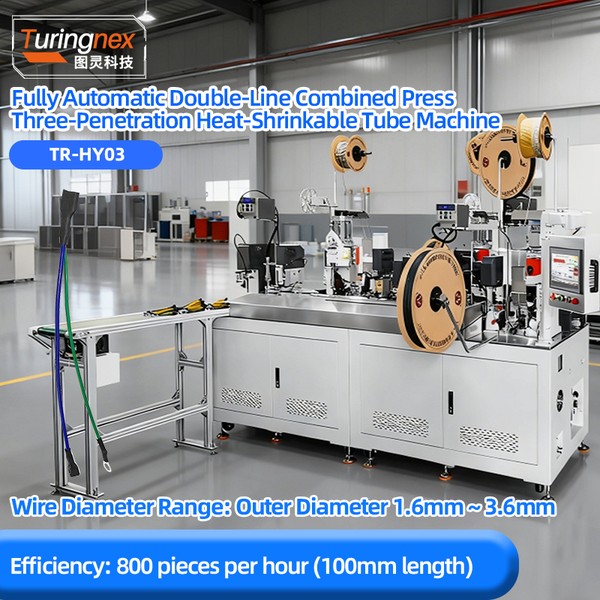
For double-ended or multi-position parts, combined machines such as the TR-HY03-DL class (fully automatic double-line combined press with three-penetration heat-shrinkable tube feeding — the name describes its workflow: two lines, press, and heat-shrink tube insertion) remove entire handling steps.
4. Choosing between standalone and combined
Ask four questions:
- Volume per part type — below ~1,000/day: standalone baking plus manual insertion is often enough. Above that, automate insertion.
- How many tube/part variants — many variants favor standalone machines with quick changeover; few variants favor combined setups.
- Is your bottleneck insertion or baking? Time both. Automate the slower one first.
- Floor layout — a combined machine replaces several stations; make sure the upstream (crimp) and downstream (test/pack) flow can keep up.
5. Quality criteria that matter
- Temperature control: consistent heat profile across the working zone, adjustable per tube material (PVC, polyolefin, etc.)
- Coverage repeatability: tube position over the crimp must not drift
- Gentle handling: the mechanism must not damage seals, insulation or neighboring wires
- Safety: hot zones guarded; e-stop accessible; extraction of fumes where required
6. RFQ checklist
- Tube diameters and lengths (smallest and largest)
- Tube material and shrink ratio (e.g., 2:1, 3:1)
- Single-ended or double-ended parts; how many tubes per part
- Wire length and whether parts arrive crimped or must be crimped in-line
- Current manual pieces/hour (your baseline for payback)
- Acceptance sample: send 20–50 finished examples
7. Pitfalls
- Testing with the wrong tube: shrink ratio and material change heat requirements — test with your production tube, not a sample the supplier picked
- Ignoring the upstream step: if insertion is manual and slow, a faster baking machine only moves the bottleneck
- Buying one giant line for a job that needs flexibility — combined lines are powerful but rigid; match flexibility to your variant count
FAQ
Q: Can a baking machine shrink tubes of different sizes without changeover? A: Within a working range, yes — adjustable temperature/feed zones handle a range of diameters. Confirm the machine's tube range against your smallest and largest sizes.
Q: My parts arrive pre-inserted from another workshop. What do I need? A: A standalone baking machine sized for your throughput. Specify your part geometry and hourly target.
Q: Does automation really protect tube position better than a careful operator? A: For long runs, yes — the machine repeats the same insertion geometry every cycle. For short runs with unusual parts, a skilled operator can still be faster; that is the flexibility argument for standalone machines.