
Why the baking stage decides shrink quality
A heat-shrink tube can be fed, cut and inserted perfectly — and still fail if the baking stage is wrong. Underheated tube does not shrink fully and later slips; overheated tube burns, embrittles or shrinks unevenly around the terminal. The baking machine is therefore not an accessory to the insertion line; it is the stage that locks in the seal. This guide covers the three decisions that matter when buying a baking stage: heating method, temperature control and throughput sizing.
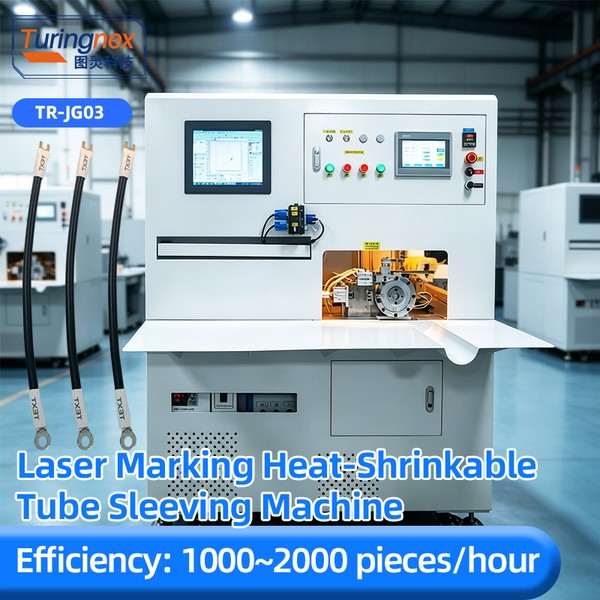
The three heating approaches compared
| Heating method | How it works | Best for | Watch out for |
|---|---|---|---|
| Hot-air oven | Forced heated air around the part | Even, controlled shrink over a range of tube sizes | Airflow must be even; slower heat-up |
| Infrared / quartz heating | Radiant heat, fast response | High-output lines, larger tubes | Needs shielding to avoid overheating wire insulation |
| Hot-air tunnel / chain conveyor | Continuous bake while parts travel | Automated insert-and-bake cells | Length and conveyor speed set the dwell |
Most dedicated heat-shrink baking machines and inserting heat-shrink tube baking machines use temperature-controlled hot air, because it shrinks the tube evenly without scorching the wire.
The three specifications that matter
1. Temperature range and stability
- Check the *usable* range, not just the maximum. For standard cross-linked polyolefin tube the working band is roughly 120–200 °C; PTFE and higher-rated tubes need more.
- Ask for the control tolerance: ±5 °C or better around the set point. A machine that swings ±20 °C will over-shrink one part and under-shrink the next.
2. Dwell time and oven length
Shrink quality is temperature × time. A short oven forces a hotter, faster bake and a smaller safety margin; a longer heated zone at moderate temperature shrinks more uniformly.
- For a conveyor machine, the relationship is simple: required dwell time × line speed = heated length. If your target cycle needs 6 seconds of soak at 180 °C and the line runs 600 parts/h, the heated zone must be long enough to hold 1 part per second × 6 s — i.e. at least 6 part positions under heat.
- If parts leave the oven still half-shrunk, the conveyor is too fast for the heated length.
3. Output and footprint
- Sizing rule: define the slowest acceptable stage — insertion, baking or cooling — and buy the other stages to match. Baking is usually sized last because it takes the most floor length.
- A combined machine that inserts the tube and bakes it in one pass (our double-line combined press with three-penetration heat-shrinkable tube configuration) removes the separate handling step between insertion and baking, which is where misalignment and dropped parts happen.
Practical selection checklist
1. List your tube diameters and materials, and confirm the required shrink temperature band. 2. Measure the current bottleneck: how many inserts per hour must the baking stage absorb? 3. Decide heating method by tube mix: uniform mixed sizes favour hot air; long high-output runs may justify IR for speed. 4. Ask the supplier for a temperature-uniformity statement and a real test bake with your own tube and terminal samples. 5. Check safety and ergonomics: heated-zone guarding, cooling section, and easy cleaning of flux or adhesive residue from the chamber.
Integrating baking with insertion
For shops assembling sealed wire-to-terminal joints with heat-shrink sleeves, the process flow is: strip → crimp → insert tube → bake → cool. Whether you buy them as separate stations or as a combined machine depends on volume and changeover frequency:
- Low volume, many tube sizes: separate tube insertion and baking stations, quick to change over.
- High volume, few variants: one integrated insert-and-bake cell, where the tube position is fixed by the machine and the bake starts immediately — see our guide on choosing between insert-and-bake and combined machines for the full trade-off.
FAQ
What temperature shrinks standard polyolefin tube? Around 120–200 °C depending on the tube rating; the supplier datasheet shrink temperature is the starting point. Always verify with your actual tube.
Can I use one oven for PTFE and polyolefin tube? Only if the control range and airflow suit both — and never exceed the lower-temperature part's rating in mixed batches.
Why does my shrink look uneven even at the right temperature? Usually airflow or part positioning — one side of the tube faces the air stream. Even heating requires parts to be presented consistently, which is why conveyor orientation matters.
Bottom line
The baking stage must be chosen by temperature stability, dwell capability and throughput — not by oven length alone. Define your tube mix and target output, run a test bake with real samples, and choose a machine whose heated zone matches your cycle time. Tell us your tube range and hourly target and we will size the baking stage honestly — including when the answer is "your current oven is already enough".