
Most harness shops buy machines one job at a time — a rush order arrives, a press is purchased, and the shop's capacity drifts wherever those orders point it. The result is the classic owner problem: machines that are either idle or overworked, delivery promises that slip during peaks, and capital tied up in equipment that runs one shift a week. Capacity planning fixes that by deciding how many machines, of what class, and on what shift pattern your order book actually needs.
Start with demand, not with machines
Before counting machines, count work. Take your last 12 months of orders and separate three numbers:
- Average weekly demand — the volume your line must absorb over a year.
- Peak weekly demand — the worst month, usually automotive ramp-ups or appliance season.
- Batch structure — how many different wire/terminal combinations run in a typical week. This number decides changeover load, which often limits throughput more than machine speed.
A shop whose peak is 30% above average can normally flex with overtime. A shop whose peak doubles or triples — seasonal, project-based, or EV-ramp business — needs planned spare capacity or a partner line, not heroics from operators.
Convert demand into machine hours
Every machine class has a real-cycle throughput and a real utilisation. For crimping lines, use the machine's rated output discounted to about 70-80% for loading, rejects and small interruptions:
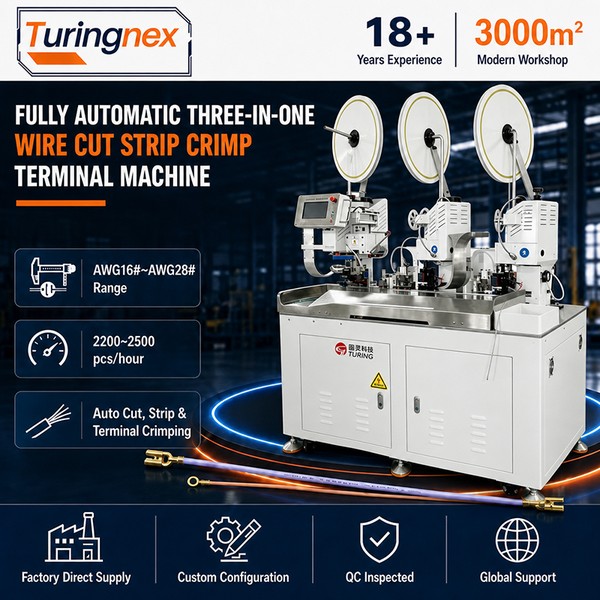
- A fully automatic double-head or three-in-one line such as the TR-HY03 three-in-one crimping machine (rated 2,200-2,500 pcs/hour on wires under 300 mm, with ±0.4% cut tolerance and ARM 12-axis servo control) runs cut, strip and double-wire crimping in one pass. One such line typically replaces two or three operator-fed stations.
- A dedicated double-head workhorse like the TR-TC02 automatic double-head five-wire crimping machine (about 150 pcs/min, servo and stepper driven) is the right unit when your product is a family of double-ended leads and you want the fastest payback per square metre.
- For mixed multi-core work, the TR-TC06 multi-core stripping and terminal crimping machine (about 700 pcs/hour with servo/stepper control) and the TR-17T multi-core sheathed-wire double-head machine cover jobs that single-conductor lines cannot touch.
The discipline: compute required weekly machine-hours as demand divided by (rated output × utilisation), then add changeover allowance of roughly 8-12% when your batch count is high. Only then do you know how many machines and shifts you need.
Plan the shift structure first
Before buying a second machine, ask whether one machine on two shifts beats two machines on one shift. A three-in-one automatic line running two shifts usually beats a second bench station on one shift for the same capital — but only if you have two trained setup operators, because a fully automatic line that stops at 5 p.m. is a fully automatic line earning half its rent. Capacity plans should be written as machine × shift × utilisation, not machine count.
Where bench and semi-automatic capacity still belongs
Automatic lines earn their keep on repeatable, high-volume leads. But every shop carries low-volume tails: prototypes, repair wires, custom lengths, odd terminals. Bench and semi-automatic stations absorb that tail without burning automatic-line time. Plan them deliberately: one flexible station per two automatic lines is a common starting ratio, so small-batch work never blocks the line that pays the rent.
Build the decision table
| Demand profile | Typical answer | Machines to evaluate |
|---|---|---|
| Under ~50k crimps/week, many variants | 2-4 bench/semi-auto stations, one shift | TR-ZD26, TR-JD22 mute presses; TR-18 cold-crimp press |
| 50-200k/week, stable families | 1-2 automatic lines + 1 flexible station | TR-HY03, TR-TC02, TR-TC05 |
| 200k+/week or EV/automotive ramps | Automatic lines on 2 shifts + buffered material flow | TR-HY03, TR-SZ03 bulk line, TR-TC06 |
| Multi-core / jacket work | Sheathed-wire family machines, staged | TR-17T, TR-1800S |
Automation is a capacity decision, not a labour decision
When labour is scarce — the situation most shops are in — automation is how you buy capacity that does not need a recruiter. A TR-1800S multi-functional peeling and crimping machine or a TR-HY03 class line removes the operator's hands from the cycle, which both raises output per shift and makes quality less dependent on who is working that day. Capacity plans written around automated lines are also easier to scale: adding a second shift to an automatic line is a scheduling change, not a hiring campaign.
The plan that works
1. Write down average and peak demand and your batch count. 2. Convert to machine-hours at 70-80% utilisation plus changeover allowance. 3. Decide shift structure before machine count. 4. Keep a flexible bench station for the low-volume tail. 5. Re-check quarterly — order books move faster than machines depreciate.
If you send us your weekly volume, batch count and wire/terminal mix, we will turn this into a concrete machine list with rated outputs — so the capacity number on the plan matches the machine on the floor.