
When a bench-top stripper becomes the constraint, the reflex is to buy a second one and a second operator. On large volumes of light-gauge wire that is usually the expensive answer. A double-wire head feeds, cuts and strips two wires in a single cycle, which doubles output from one machine and one operator without adding floor space — and without adding a second operator to train and supervise.
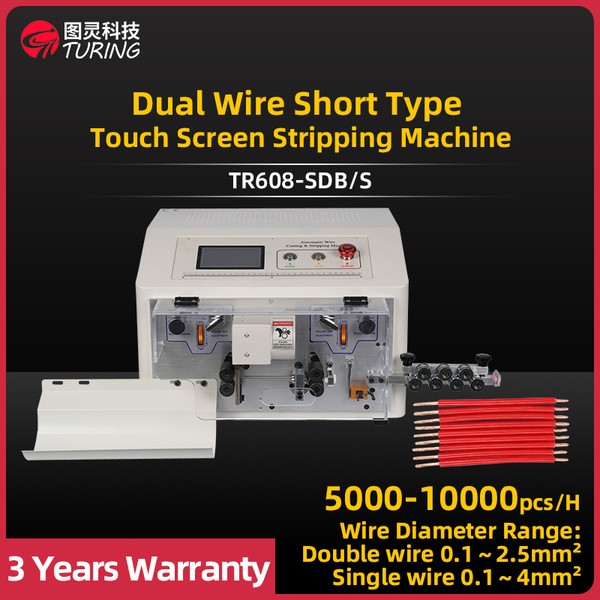
What actually changes inside the machine
A double-wire head carries two conduits and a split blade set, so both wires are driven, cut and stripped on the same cycle. The wire range narrows accordingly: the head that strips a single 4 mm² conductor strips two 2.5 mm² conductors, because two wires have to share the blade opening and the drive's grip. Nothing about the machine's footprint changes — same frame, same bench space, same controller.
Control-panel choice is independent of throughput. The touch-screen and button-panel versions of the same model carry the same mechanical head, so the decision between them is about how the operator sets and recalls programs, not about capacity.
The double-wire models in this range
| Model | Wires per cycle | Wire range | Output | Strip length | Notes |
|---|---|---|---|---|---|
| TR608-SD/S, TR608-SD/N | One | 0.1-4 mm² (tube Ф6) | 4,000-5,000 pcs/h | Cut length 1-9,999 mm | Four-wheel stepper drive, 0.1 mm per step; tungsten-carbide blade |
| TR608-SDB/S, TR608-SDB/N | Two, simultaneous | Double wire 0.1-2.5 mm²; single wire 4 mm² | 5,000-10,000 pcs/h | Head 0-20 mm, tail 0-15 mm | The double-capacity reference of the family |
| TR608-SDB2/S | Two, with tube jumping | Up to 2.5 mm² | Set by cycle | Head up to 30-40 mm | Automatic tube-jumping structure for long strip lengths |
| TR608-JE/S | One, 6 mm² class | 0.1-6 mm² (tube Ф8) | 3,000-5,000 pcs/h | Head up to 30-40 mm | Ф8 tube, high-speed steel blade, 300 W motor |
| TR608-JE2/S | One, 10 mm² class | 0.1-10 mm² (BV hard wire to 6 mm²) | Set by cycle | Head up to 40 mm | Ф10 tube, motor-driven tube jumping, 450 W |
The real limit on a double-wire head is the wire, not the machine
Two wires running through one head must be the same gauge and the same wire type, or the blade depth that suits one will nick or under-cut the other. In practice this suits shops that run long batches of a single specification — a lighting harness, a sensor lead, a standard appliance wire — rather than job shops that change wire on every order. Before ordering, check whether your production plan can batch the work by wire size. If it cannot, the double head will sit idle while single wires run through it one at a time, and the capacity gain never appears.
When the strip length is the problem, not the throughput
Stripping a 30-40 mm tail from a short lead is a different difficulty from stripping fast. A standard head retracts the guide tube as the wire leaves, and on a long strip the waste jacket has nowhere to go — it catches on the tube mouth and jams, or drags the fine strands with it. The models designated with tube jumping address this with an automatic structure that clears the jacket during retraction, which is why they are quoted with strip lengths up to 30-40 mm rather than the 15-20 mm of a standard head.
If your process needs long tails on light wire, that is the specification to raise with the supplier first. It is more often the reason a machine disappoints than throughput is.
Four wires: the next step up
Above the double-wire head, a four-wire head feeds and strips four conductors synchronously, with a forward and reverse straightener to keep them aligned. The trade-off is the same one, taken further: the per-wire gauge drops again (four 2.5 mm² conductors against a single 10 mm²), and the machine needs 500 W to drive four wires at once. Compared against running two double-wire machines, one four-wire machine saves a frame and an operator; compared against running a mixed production plan, it constrains wire selection more tightly still.
Choosing between single, double and four
- Mixed, small batches, frequent wire changes: single wire. Flexibility is worth more than capacity.
- Long runs of one light gauge, one operator: double wire. The best capacity-per-dollar step in this range.
- Very high volume of a single light gauge, dedicated line: four wires, provided the wire specification can be fixed.
- Medium and heavy gauge (6-10 mm²): single-wire machines rated for the gauge, with tube jumping if long tails are needed.
What to send us
- The wire specification and gauge range, and whether two wires will always be identical.
- The required strip length at head and tail.
- Cut length range and tolerance.
- Pieces per shift, so the throughput figure can be checked against a real cycle time.
- Your daily batch pattern — how many wire changes per shift.
Send a wire sample and the strip drawing, and we will confirm whether a double-wire head pays back at your volume or whether a single-wire machine with more flexibility is the honest recommendation.