
"Buy it and it will pay for itself" is a sentence owners hear from every salesperson, and it is almost never backed by arithmetic. The return on a crimping machine is real — but it comes from four specific, measurable sources, and each can be computed with numbers you already have. Run this framework on your own figures before you commit, and the payback calculation stops being a sales pitch and becomes a spreadsheet.
The four return streams
1. Labour saved. Count the operators the machine removes from the process. A bench station needs one operator per press; a double-head or three-in-one automatic line needs one or two per line. If a line replaces four bench stations, the saving is roughly two to three FTE of direct labour — at your loaded labour cost, that is often the largest single number in the model.
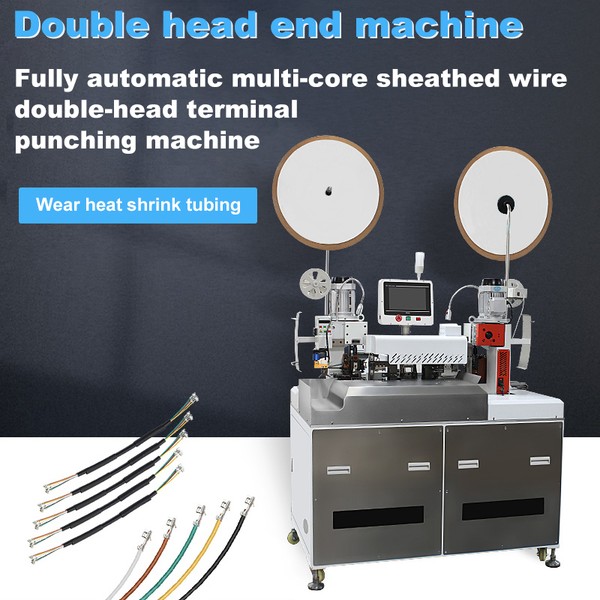
2. Output gained. Compare rated capacity realistically: the TR-17T fully automatic multi-core sheathed-wire double-head machine or the TR-HY03 three-in-one (2,200-2,500 pcs/h under 300 mm) runs while operators sleep — literally, on a second shift. Any order you currently turn away for capacity is revenue the machine can capture.
3. Scrap and rework cut. If your reject rate runs 1-3% and rework consumes a third of your quality staff's time, an automatic line with stable feeding and crimp-force control — the TR-SZ03 bulk tubular machine, TR-DS05 or TR-TC05 class — typically halves that. Multiply the improvement by your annual material and rework spend.
4. Changeover and overhead won. Covered in our changeover guide: batching and quick-change machine classes recover hours of press time a week — hours that need no extra machine at all.
The model in five lines
For the machine you are considering, fill in:
``` A = annual labour saved = FTEs removed × loaded cost × 12 B = annual margin on new output = extra pcs/h × utilisation × shifts × margin C = annual scrap/rework saved = reject-rate cut × annual material & rework spend D = annual recovered capacity = setup hours saved/week × 48 × margin per hour Annual benefit = A + B + C + D Payback (months) = (machine price + tooling + installation + training) × 12 / Annual benefit ```
Keep utilisation honest: 70-80% of rated output, not the nameplate. Keep the margin on new output conservative — if you are not sure you can sell the extra capacity, set B to zero and the machine must still pay back on A + C + D alone. That is the test of a genuinely justified purchase.
Worked example: replacing four bench stations
A shop runs four single-end bench stations, one operator each, on double-ended automotive leads. It replaces them with one automatic double-head line — the TR-TC05 class (about 3,500 pcs/h) or TR-DS05 for pre-insulated types:
| Item | Conservative numbers |
|---|---|
| Labour saved (2 FTE net) | ~$18,000-30,000/yr depending on wage |
| Scrap/rework cut | $3,000-8,000/yr |
| Extra shift capacity captured | $10,000-25,000/yr margin |
| Recovered setup time | $2,000-5,000/yr |
| Annual benefit | ~$33,000-68,000 |
| Machine + tooling + install | ~$25,000-45,000 |
| Payback | ~6-14 months |
The wide ranges are why you run the model with your own numbers — wage, margin and reject rate dominate the answer, not the machine price.
Pitfalls that destroy ROI models
- Buying the faster machine than the batch structure needs — speed you cannot feed with work is depreciation, not return. Match the class: TR-HY03/TR-TC05/TR-DS05 for steady double-end volume, TR-SZ03 for bulk tubular at line speed, TR-028 and TR-17T for sheathed multi-core.
- Ignoring tooling cost — dies for each terminal family are part of the investment; a family you add next year is another line item.
- Counting labour at wage, not loaded cost — with recruitment and training, loaded cost is typically 1.3-1.6× wage, and in tight labour markets the real constraint is that the operator does not exist to hire at any wage.
- Forgetting the second shift — the cheapest capacity expansion in the model is usually the shift the machine can run without you.
Run the five-line model, set B to zero if you must, and buy when payback on the conservative case fits your capital policy. If a machine cannot pay back on what it saves and stabilises — labour, scrap, changeover — it will not pay back on hope.