
Maintenance is usually treated as an afterthought — until a line stops on a Monday morning with a customer's delivery due on Tuesday. Then the "repair" costs more in lost output than the machine did in a month. The economics are simple: an unscheduled stop on a two-shift automatic line can cost hundreds of dollars per hour in lost production and late-delivery penalties, while a preventive maintenance hour costs a fraction of that. Owners who treat maintenance as a budget line, not an expense line, keep their machines running at the lowest total cost.
Price the downtime first
Before deciding what maintenance is worth, put a number on an hour of downtime: lost output (machine rate × utilisation), idle labour you still pay, and expedite/penalty risk on committed deliveries. For an automatic line rated at thousands of parts per hour, that number is sobering — and it tells you the maintenance budget that is rational. Rule of thumb used by harness shops: preventive maintenance cost should run about 1-3% of machine value per year for bench equipment and 3-5% for automatic lines, and every unscheduled stop you avoid with it pays the budget many times over.
What preventive upkeep actually covers
A practical schedule for crimping and wire-processing machines:
- Daily (10 minutes per station): blow out terminal dust and wire debris, check the strip-feed path, verify guards and emergency stops, log cycle counts.
- Weekly: lubricate slides and links per the manual, check crimp-height stability with a sample crimp, inspect dies for wear, verify air pressure and filtration where the machine needs air.
- Monthly/quarterly: tighten electrical connections, inspect servo/stepper cables and connectors, check belt/pulley tension, deep-clean the controller cooling.
- Annually: full mechanical inspection by the supplier or a trained technician, calibration checks, replace consumables (dies if worn, feeder parts, filters).
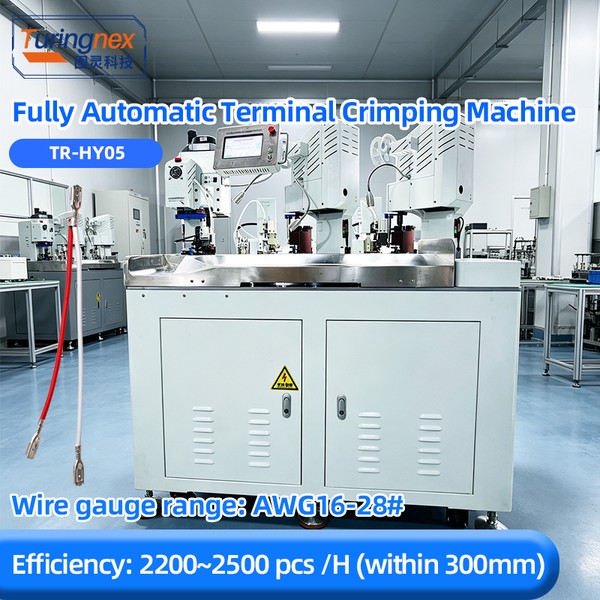
Machines with PLC/touch-screen control — the TR-HY05 three-in-one, TR-TC02 double-head, or the TR-8030YJP stripping-with-marking machine — simplify this because diagnostics, cycle counts and fault history are on the screen: log the counters weekly and the machine tells you when service is due instead of surprising you.
Spares: hold the right ones, not everything
Stocking every spare is as wasteful as stocking none. The rational list for a crimping/processing line:
- Consumables that fail often: dies and applicators for your active terminal families (see the changeover guide for kit discipline), feeder parts, blades.
- Electronics with long lead times: controller boards, drives, sensors — one each for the machine class that carries your main volume.
- Safety parts: guards, interlocks, emergency-stop components must be replaceable immediately, for compliance as much as uptime.
For a machine that runs your main volume — say the TR-HY05 three-in-one or an ultrasonic welder like the TR-206Z desktop or TR-2020X (3,000/5,000 W, 20 kHz) — ask the supplier for a recommended spares kit matched to the machine and your shift pattern. The kit costs a fraction of one unscheduled stop.
Service expectations: set them before you buy
The best time to negotiate service is at purchase, not after a breakdown. Four questions every owner should ask the supplier:
1. Response time: what is the guaranteed response for a production-stopping fault — same day, 48 hours, remote first? 2. Remote diagnostics: can the supplier read the PLC/touch-screen fault log remotely or over video to pre-diagnose before a visit? On-screen diagnostics (standard on TR-HY05 class machines) make this practical. 3. Training: does the price include operator and maintenance training, and is documentation (wiring diagram, spare-parts list, lubrication chart) delivered with the machine? 4. Warranty and parts availability: most Turingnex machines carry a 1-year warranty — confirm what is covered, what the spare-parts lead time is, and whether dies for your terminals are supplied as matched sets.
Maintenance economics on one page
| Decision | Economics |
|---|---|
| Preventive upkeep at 1-3%/yr of value | Costs a few percent; avoids stops that cost $100s/hour |
| Hold the critical spares kit | One stop avoided pays for years of kit cost |
| Remote diagnostics | Cuts most faults to a phone call or video session |
| Service SLA agreed at purchase | Removes the worst case: a machine down while the supplier is "checking schedules" |
Owners who run this model keep automatic lines above 90% availability and bench equipment out of the emergency-repair cycle entirely. The machine is an asset that earns while it runs — maintenance is simply the cost of keeping it earning.