
Two ways to make a soldered joint at volume
Where the drawing says "soldered connection" — waterproof leads, sealed terminals, appliance and some automotive subassemblies — there are two production routes. One dips the wire end in molten solder and then crimps/solders the joint; the other crimps a terminal that carries a solder preform ring and then heats it until the ring melts and seals the joint. Both end with solder inside the joint; they differ in process steps, floor space, defect modes and cost. This guide compares them so you can choose by your terminal design and volume.
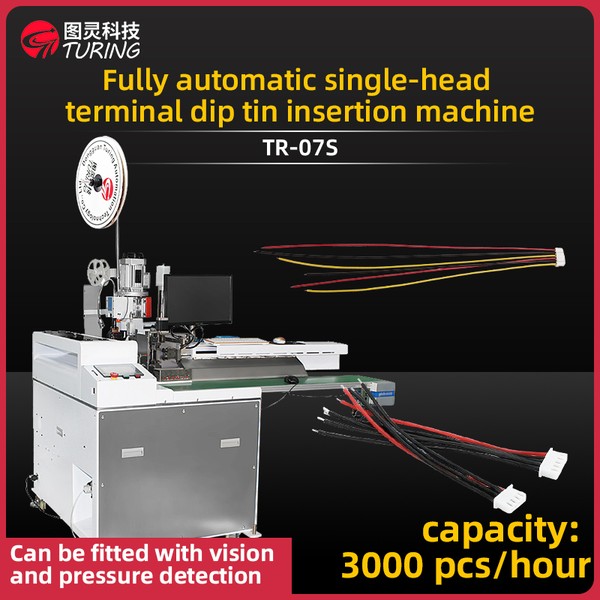
Route 1: tin-dipping line
Strip → dip the wire end in solder → crimp or assemble → (often) heat-shrink or seal.
Strengths
- Terminal choice is free — any standard terminal works because the solder is on the wire.
- Simple, familiar process; low tooling cost per terminal.
Limitations
- More handling steps between stripping and the final joint.
- Dipping quality depends on temperature, depth and dwell control (see our tin-dipping machine guide).
- The joint is soldered to a *tinned wire end*; the terminal barrel may still need a separate operation for sealing.
Route 2: solder-seal preform crimping
Strip → crimp a solder-seal terminal (with a preformed solder ring inside the barrel) → heat the barrel to melt the ring → cooled, sealed soldered joint exits complete.
Strengths
- One machine family (fully-automatic crimp-solder-seal machines) produces the finished sealed joint — crimp and seal in one automated sequence.
- Consistent solder volume per joint (the preform is the same every time), which is hard to match with dipping.
- Fewer handling steps, stronger fit for high-volume, audited production.
Limitations
- Requires terminals designed for solder preforms — not every terminal accepts the ring.
- Preform terminals usually cost more per piece than plain terminals.
- Heating step must be controlled so the solder flows fully without wicking up the wire.
Choosing between them
| Factor | Tin-dipping line | Solder-seal preform |
|---|---|---|
| Terminal compatibility | Any standard terminal | Terminals with solder preform |
| Solder consistency | Depends on bath control | Preform = fixed solder volume |
| Process steps | Strip → dip → crimp/assemble | Crimp+seal in one machine |
| Throughput potential | Medium (multi-step) | High (single automated pass) |
| Best for | Mixed terminal ranges, lower volume | High-volume sealed leads, audited lines |
Choose dipping when your terminals are standard, volume is moderate and you already run a stripping line that can feed a dipping station. Choose solder-seal when your terminal design accepts a preform and you want a repeatable sealed joint at high output — this is the route most waterproof-lead producers take once volumes justify the terminal cost.
What to verify before automating either route
1. Terminal availability. For solder-seal: confirm your terminal supplier offers preform versions in your sizes; a machine is worthless if the terminal is not produced. 2. Heating method and control. Preform machines heat the barrel (resistance or hot-air); verify even heating for your largest and smallest terminal so solder flows fully without wicking. 3. Sealing integrity test. Decide the acceptance check: pull test, air-leak test where the spec demands waterproofing, and visual solder-fillet inspection. 4. Integration. Can the machine feed from your crimping or stripping line? Our crimp-seal and housing-insertion fully automatic machines integrate further into housing insertion where the sealed joint needs a plastic shell next.
FAQ
Is a solder-seal joint stronger than a dipped joint? Both are soldered joints when done correctly; solder-seal wins on consistency because the preform gives identical solder volume every cycle, while dipping varies with bath conditions.
Can I convert an existing crimping line to solder-seal? Usually not by tooling alone — the terminal must be a preform type and the machine needs a heating station. Compare the cost of conversion against a dedicated crimp-solder-seal machine.
Do sealed soldered joints still need heat-shrink? Often yes, for insulation and strain relief — the seal in the barrel stops wicking and corrosion, while heat-shrink or a housing provides the outer protection.
Bottom line
Match the route to your terminal design: standard terminals and moderate volume favour a dipping line; preform terminals and high-volume sealed leads favour solder-seal crimping in one automated pass. Send us your terminal samples and annual volume — we will test both paths on your parts and show you the per-joint cost difference before you commit to a line.