
Terminal prices get negotiated hard; nobody negotiates the cost of the crimp itself. Yet cost per crimp — the true landed cost of every completed terminal joint — is where most shops leak money quietly: a few percent of material waste, an extra minute per changeover, a reject rate nobody tracks. Small percentages compound to real money at a few hundred thousand crimps a month. Here are the five leaks, in the order they usually appear.
Leak 1: terminal waste at setup and during running
Every die change scrapes a handful of terminals — the first crimps are trial crimps, and on bench presses every operator restart repeats the ritual. Add mis-feed and misfire waste during running, and material loss of 2-5% is common. The fix is twofold: standardised setup verification (see changeover) and automatic feeding that mis-feeds less. Bulk-fed machines like the TR-SZ02 semi-automatic 2T bulk tube terminal machine or the TR-SD01 double-disc vibrating terminal machine feed loose terminals mechanically, which removes the operator's hand from the feed cycle and the trial-and-error first crimps that come with it.
Leak 2: rejects you do not count
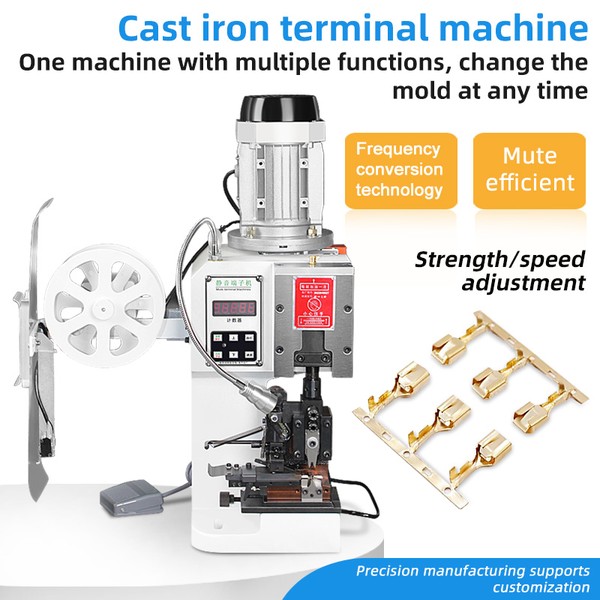
Shops that do not do pull tests or crimp-height checks typically discover rejects at the customer's incoming inspection — the most expensive place possible. Cost per crimp must include: scrap wire, rework labour, and the customer's trust. The cheap fix is measurement at the source: a die check at shift start, a pull test per lot, and — on force-controlled machines — letting the press flag its own drift. Servo and mute presses in the TR-JD22 and TR-ZD26 families (1.5-8T classes) hold repeatability far better than clutch presses, which is why the quiet, stable press pays for its premium in reject reduction alone.
Leak 3: operator time is the biggest line item
At a bench press, the operator's wage is embedded in every crimp. A semi-automatic station at 60-120 crimps per minute costs roughly 1-3 cents per crimp in labour alone depending on your local wage; a fully automatic line cuts that by an order of magnitude because one operator supervises a machine that never tires. The mute press range — TR-ZD26, TR-JD22, TR-6T — is the low-volume answer; the TR-TC07 high-speed semi-automatic FFC machine (around 9,500 points/h) is the high-rate bench answer; and beyond that, automatic feeding takes over.
Leak 4: changeover minutes are pure cost
If a shop runs 20 batches a week and each changeover costs 20 minutes of idle press plus 30 minutes of operator setup, that is 15+ hours a week of paid time producing nothing. Cost per crimp rises steeply with batch count unless changeover is attacked. For small presses the fix is tooling discipline: preset dies, documented setups, and dies that seat without shimming. For higher volume, batching by wire/terminal family keeps the press running longer between setups — the same logic that makes a TR-15T semi-automatic 15T press or a mute family machine the workhorse of a well-organised small shop.
Leak 5: buying power you do not use
The last leak is capacity economics: a press that runs one shift at 40% utilisation costs the same depreciation as one running two shifts at 85%. Matching machine class to demand — a mute or bulk semi-automatic for modest volume, an automatic line for steady volume — means you never pay automatic-line capital for bench volume, nor bench labour rates for line volume. This is where the decision table in our capacity planning guide pays off directly in cost per crimp.
A monthly cost-per-crimp review
| Component | Where it hides | Action |
|---|---|---|
| Terminal material | Setup scrap, mis-feeds | Track scrap kg per lot; move to bulk feeding (TR-SZ02, TR-SD01) |
| Rejects | Post-shipment claims | Pull test per lot; crimp-height checks (TR-ZD26 class presses) |
| Labour | Operator at each station | Match machine class to volume; automatic lines for steady work |
| Changeover | Idle press + setup time | Preset dies, batch sequencing |
| Capital | Idle machines | Shift structure before machine count |
Run this review monthly for three months and you will find that cost per crimp drops 10-25% without a single new machine — and where it does not, you will know exactly which machine investment closes the gap.