
Stripping is the most common first process in a harness shop — and the one where a wrong machine choice wastes the most operator time. Two families dominate the market: pneumatic semi-automatic strippers and computer-controlled (servo/PLC) stripping machines. They are not competitors for the same job; they suit different wire types and batch structures. This guide helps you place each machine where it earns money.
1. Understand the real difference: who controls the blade
Pneumatic semi-automatic machines clamp the wire, and the operator (or a foot switch) triggers air-powered blades that cut the insulation. Blade depth and strip length are set by mechanical stops or simple controls. They are fast to set, forgiving to learn, and built for bench work on medium and large wires.
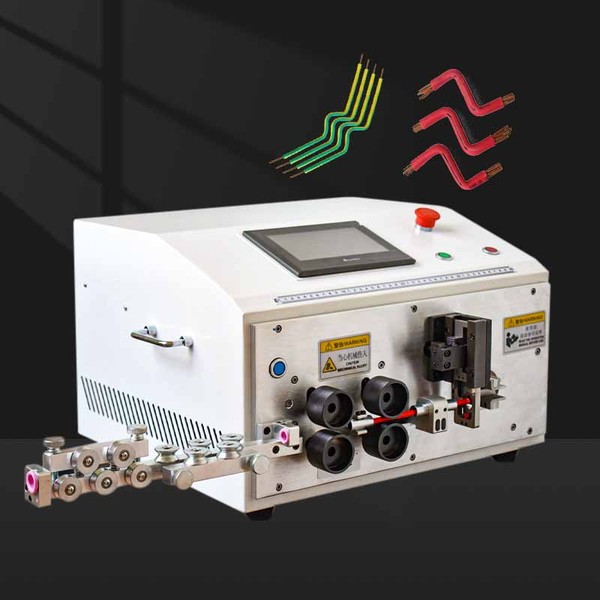
Computer-controlled stripping machines use servo-driven blades and programmable parameters: strip length, blade depth, number of strips, and often a full sequence such as strip → mark → cut. Programs can be saved per wire type and recalled instantly. They are the workhorses of high-mix, high-volume stripping floors. In our catalogue this family is computer wire stripping machines, with more than a hundred models covering wire from fine electronics gauge up to large cross-sections.
2. When the pneumatic semi-auto is the better buy
Choose pneumatic semi-automatic machines when:
- Wire is medium-to-large and insulation is thick (power cords, appliance leads, automotive battery cables)
- Batches are short and frequent, and changing a mechanical stop takes seconds
- Operator training matters more than cycle time — new staff can be productive on day one
- You need a robust, low-maintenance bench tool, not a production center
Pneumatic machines in our range are grouped under semi-automatic pneumatic wire stripping machines and semi-automatic coaxial wire stripping machines for shielded/coaxial constructions, where blade control around the braid is critical.
3. When the computer-controlled machine pays back
Move to computer-controlled stripping when:
- Batch sizes grow and setup time between wire types becomes the bottleneck — stored programs cut changeover from minutes to seconds
- Stripping quality must be repeatable across shifts — servo blade depth removes the "good day / bad day" factor
- You need combined functions: marking, multi-stage stripping, or a complete strip-and-cut sequence in one pass
- Many wire types must be documented and reproducible for audits
Machines with marking function, such as the TR-8030YJP class (computer-controlled stripping with marking, PLC/touch-screen control), remove a separate printing step from your floor. If your customer requires wire marking on every lead, a combined strip-and-mark machine is often cheaper than buying a printer plus a stripper.
4. Side-by-side comparison
| Decision factor | Pneumatic semi-auto | Computer-controlled |
|---|---|---|
| Blade depth control | Mechanical/simple settings | Servo, programmable per program |
| Setup between wire types | Seconds (mechanical) | Instant via saved programs |
| Operator skill needed | Low | Low–moderate (programming) |
| Output on long runs | Operator-paced | Machine-paced |
| Batch economics | Short runs | Medium–long runs |
| Combined functions | No | Marking, multi-strip, cut sequences |
| Typical wires | Power, appliance, thick insulation | Fine to medium, high-mix production |
| Maintenance | Simple | Moderate (electronics) |
5. The wire-type test: three quick questions
- Smallest wire: below ~0.5 mm² with thin insulation? Computer-controlled blade control is safer.
- Insulation: thick, soft (rubber/silicone) or braided? Pneumatic blades with depth stops handle tough insulation well; silicone needs gentle, controlled cutting to avoid nicking.
- Volume per wire type: over a few thousand pieces per run with few changes? Computer-controlled wins on cost per piece.
If your answer to question 3 is "many short runs," stay with pneumatic — a computer machine would spend its advantage on changeovers.
6. Coaxial and shielded wire: a special case
Shielded wire needs controlled cutting of the jacket without nicking the braid or dielectric. General-purpose machines may not give you the fine blade staging coaxial requires. If coaxial or shielded constructions are part of your mix, look at the dedicated fully automatic coaxial wire stripping machines rather than adapting a general machine — blade staging and depth profiles differ fundamentally.
7. Checklist for your shortlist
- Wire range you must cover (smallest and largest conductor)
- Insulation types (PVC, silicone, rubber, braided, coaxial)
- Strip length: single end, both ends, multi-stage?
- Marking required on the wire?
- Cut length range and tolerance
- Batch structure: average pieces per setup
- Floor space, air supply (if pneumatic), power supply
FAQ
Q: Can a computer stripping machine also do short bench jobs economically? A: Yes, but a semi-automatic bench machine is often faster to set for a one-off. Many shops keep one pneumatic bench stripper for odd jobs and run the computer machine for production.
Q: My insulation is silicone — any special requirement? A: Soft silicone needs precise blade control; an over-deep blade can nick the conductor. Servo-controlled depth (computer machine) or a well-set pneumatic stop with soft-blade kits is recommended. Ask the supplier for a wire sample test before ordering.
Q: Do I need compressed air for computer-controlled machines? A: Some use air for clamping/feeding; others are fully electric. Confirm air consumption and pressure (typically 0.5–0.7 MPa) in the specification sheet — and check your workshop compressor capacity.