
The first decision in cold-press terminal crimping has nothing to do with speed — it is the terminal format. Loose (bulk) tubular terminals arrive unconnected and are fed one at a time; banded pre-insulated or sleeved terminals arrive on a tape or in a linked chain and feed automatically. Those two formats split the machine market into different classes with different economics. This guide maps thirteen Turingnex machines against that split so you can choose by terminal form, wire range, crimp precision, output and automation level — in that order.
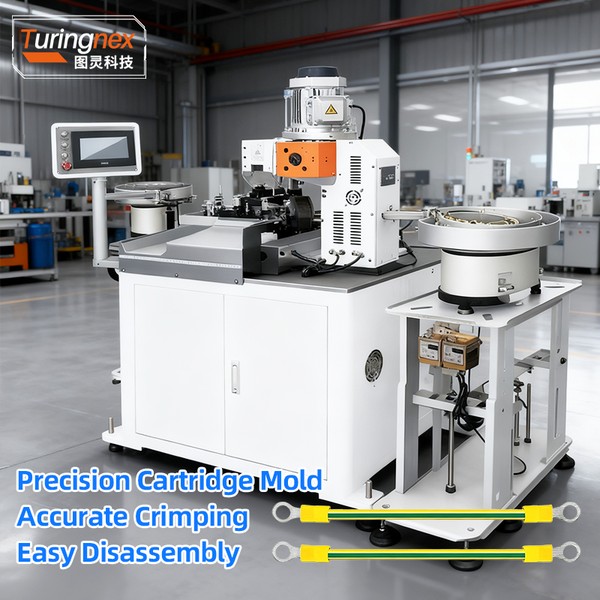
Why the terminal format decides the machine class
A tubular (管形) cold-press terminal crimps a bare barrel over a stripped conductor; a pre-insulated or sleeved terminal adds insulation that must be oriented correctly before crimping. When terminals are loose, the machine or the operator must place each one; when they are banded or chain-fed, the machine pulls them from a strip and orientation is mechanical. The practical consequences:
- Loose terminals: flexible, no reel required, but placement is the bottleneck — the machine class runs from bench semi-automatic presses to automatic bulk machines with vibratory or tube feeders.
- Banded/chain terminals: the strip is the material handling system — automatic double-head machines and cut-strip-crimp lines dominate, and cycle time stops depending on an operator's hands.
Quality expectations apply to both: crimp height, pull-out force and insulation condition are checked against industry crimp specifications such as UL 486-series and IEC 60352-2 style requirements, which is why die fit and force stability matter as much as cycle rate.
Class 1 — loose terminal bench machines: flexible, low volume
When daily volume is modest and terminals change often, the machine should be simple and quick to change over. Four machines cover this class:
- TR-12-2 tubular terminal crimping machine — the compact tubular press, also applied to aviation pin terminals; 220 V bench operation.
- TR-18 cold crimping terminal machine — general cold-crimp press with 1-12 mm strip-length handling.
- TR-16 16 mm2 tubular terminal crimping machine — sized for larger tubular terminals (16 mm2 class) with 1-12 mm strip handling.
- TR-YJY01 semi-automatic pre-insulated terminal machine — semi-auto press for pre-insulated types with 1-18 mm strip-length range.
Advantages: lowest entry cost, operator control, fast die changes. Limits: output is capped by operator pace — typically the right machine up to a few thousand terminals per day per station.
Class 2 — automatic bulk machines: loose terminals at volume
Loose terminals do not have to stay manual. Fully automatic bulk machines feed loose tubular terminals mechanically and run a wire line at press pace:
- TR-SZ03 automatic bulk tubular terminal machine — wire range AWG 12-24, cutting 50-9,999 mm, stripping 0-15 mm, 2 t crimp force, and roughly 2,000-3,000 pcs/h (product page for range data). This is the machine that moves a shop from "loose terminals are slow" to "loose terminals at automatic-line speed".
- TR-20HMG automatic tube-feeding bulk terminal machine — adds tube-feeding of bulk terminals with 1.5-15 mm stripping and 0.5-0.65 MPa clean dry air, combining bulk feeding with sleeved-terminal capability in one automatic sequence.
Advantages: loose-terminal flexibility with automatic throughput; no dependence on operator placement. Choose this class when your terminals are tubular/bulk but your volume has outgrown the bench.
Class 3 — banded pre-insulated machines: automatic double-head work
For pre-insulated terminals supplied on band/chain, automatic double-head machines strip, crimp and process both ends in one cycle:
- TR-DS05 fully automatic double-head pre-insulated terminal machine — servo and stepper drives for the double-head pre-insulated workflow.
- TR-22D+S automatic double-end pre-insulated terminal machine — the companion double-end configuration for higher output on pre-insulated types.
Advantages: both ends processed without re-handling; insulation orientation handled by the band feeding; servo/stepper control holds repeatability. Choose this class when your leads are pre-insulated, come banded, and need both ends terminated at volume.
Class 4 — tube, marker and sleeved-type lines: from semi-auto to full cut-strip-crimp-mark lines
Sleeved and marked terminals (number tube, marker tube, end-piercing) form the most automated class, from a PLC bench machine to full wire lines:
- TR-GZ520 semi-automatic tube-type number-tube terminal crimping machine — PLC/touch-screen bench station for number-tube work at moderate volume.
- TR-09G fully automatic end-piercing number-tube machine — servo and stepper drives for end-piercing number tubes.
- TR-CG25 fully automatic wire marking tube-insertion and crimping machine — wire cutting, stripping and terminal crimping with 180-20,000 mm cutting (customisable).
- TR-2525+S fully automatic double-end marker machine — double-end marker-tube processing with 66-99,999 mm cutting.
- TR-CG01 automatic double-head wire marker tube machine — double-head marker-tube line, cutting 180-20,000 mm (customisable), marker-tube length 20 mm or 30 mm (customisable).
Advantages: the sleeved/marked joint is completed in one flow, with tube length and cut length programmable — exactly the flexibility harness markers and automotive branches need.
The thirteen machines at a glance
| Terminal form | Automation | Machines | Key real capability highlights |
|---|---|---|---|
| Loose (bench) | Semi-automatic | TR-12-2, TR-18, TR-16, TR-YJY01 | Strip 1-12/1-18 mm; 220 V; die-based changeover |
| Loose (bulk) | Fully automatic | TR-SZ03, TR-20HMG | AWG 12-24; 2,000-3,000 pcs/h (SZ03); tube feed 1.5-15 mm (20HMG) |
| Banded pre-insulated | Automatic double-head | TR-DS05, TR-22D+S | Servo/stepper; double-head pre-insulated |
| Tube/marker types | Semi-auto to full line | TR-GZ520, TR-09G, TR-CG25, TR-2525+S, TR-CG01 | Cut 66-20,000 mm+; marker tube 20/30 mm; PLC/servo |
A selection framework in five questions
1. Terminal form. Loose or banded? If your terminals arrive loose and stay loose, stay in Classes 1-2; if they are pre-insulated/sleeved on tape, go Classes 3-4. 2. Wire range. Match strip and cutting ranges to your conductor: bench machines handle short strip lengths (1-18 mm); automatic lines cut from 50 mm up to 20 m where custom. 3. Crimp precision. Check die fit to the terminal maker's profile and, on automatic machines, crimp-force stability — the 2 t class force rating on TR-SZ03 is the scale to compare against your largest barrel. 4. Output. Bench semi-auto suits up to a few thousand/day; automatic bulk (2,000-3,000 pcs/h) and double-head machines move to line pace. 5. Automation level. Single-end bench, double-head automatic, or a full cut-strip-crimp-mark line — the more steps your part needs, the further along this list you should buy.
Trends: bulk automation, integration and quality data
Three trends shape cold-press terminal processing:
1. Loose terminals are being automated, not abandoned. Automatic bulk machines (TR-SZ03, TR-20HMG) give loose-terminal shops line throughput without switching terminal supply format — important where customers keep buying loose for stock reasons. 2. The line is integrating toward the finished sleeved/marked joint. Cut, strip, crimp, tube insertion and marking are merging into one machine flow (TR-CG25/2525-S/CG01 class), because each external transfer is where small sleeves get lost. 3. Quality is data, not inspection. Crimp-force control, servo/stepper repeatability and programmable tube/cut lengths let suppliers document the joint rather than argue about it — the standard automotive and appliance audits now expect.
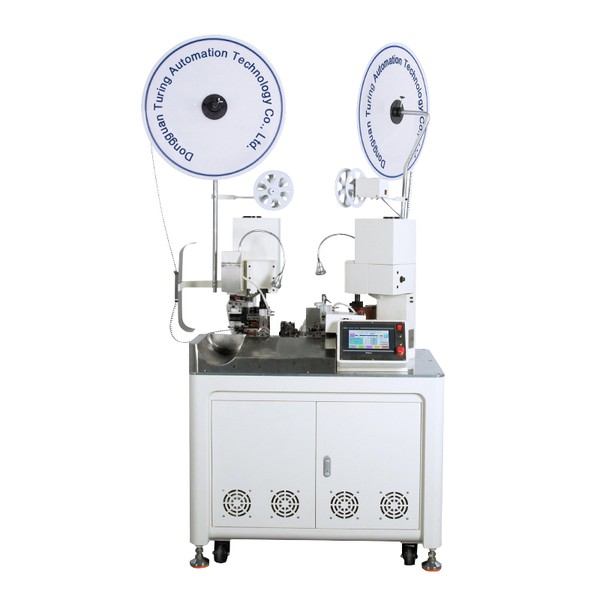
Double-head pre-insulated (servo + stepper)
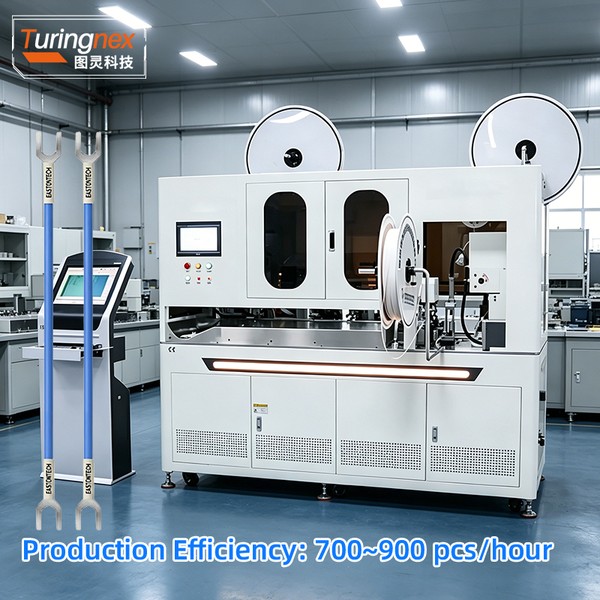
Double-end marker-tube line (66-99,999 mm cut)
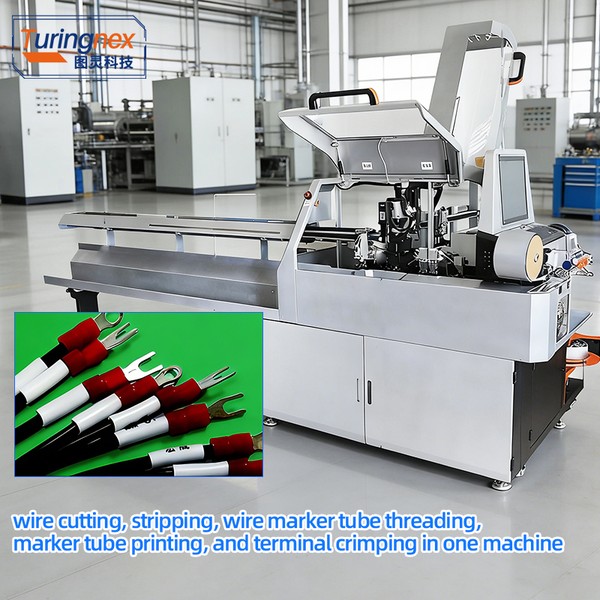
Double-head wire marker tube (180-20,000 mm cut)
FAQ
Can one machine process both loose and banded terminals? Rarely well. Loose needs a feeding method for individual barrels; banded needs strip feeding and insulation orientation. Choose by your dominant format and keep the other as a second station.
Is a bench machine enough for tubular terminals? Up to a few thousand terminals/day per station, yes — TR-12-2/TR-18/TR-16 keep changeover fast. Beyond that, an automatic bulk machine like TR-SZ03 pays for itself quickly.
What about pre-insulated and sleeved terminals? They belong to the banded classes: double-head pre-insulated machines (TR-DS05/TR-22D+S) or marker/tube lines (TR-CG25/TR-2525-S/TR-CG01), depending on whether you need marking.
Bottom line
Choose by terminal format first — loose (Classes 1-2: bench presses to automatic bulk lines) or banded/sleeved (Classes 3-4: double-head and cut-strip-crimp-mark lines) — then by wire range, precision, output and automation depth. Send us your terminal samples, wire range and target output; we will place you on the right class and recommend the exact machine, with sample crimps and pull-test results before you commit.