
Both machine types strip coax to the same standard. The difference is who feeds the cable: a fully automatic machine pulls from a reel and cuts the length, a semi-automatic machine takes one prepared piece at a time.
What the two types share
Both use a rotary cutter head that opens the layers in successive passes, and both set strip length and cut depth in hundredths of a millimetre. A semi-automatic machine is not a lesser machine in strip quality; several semi-automatic models quote nine strip layers, one more than the standard fully automatic models quote.
On the semi-automatic side the TR-5806 covers a cutting diameter of 0.8-7 mm with a maximum strip length of 56 mm, nine layers, two blades, 400 W and 26 kg. The TR-6806D widens the range to 1.5-9.5 mm and 65 mm, and uses a four-piece rotary blade head, which the company describes as giving better performance on thicker and harder cable.
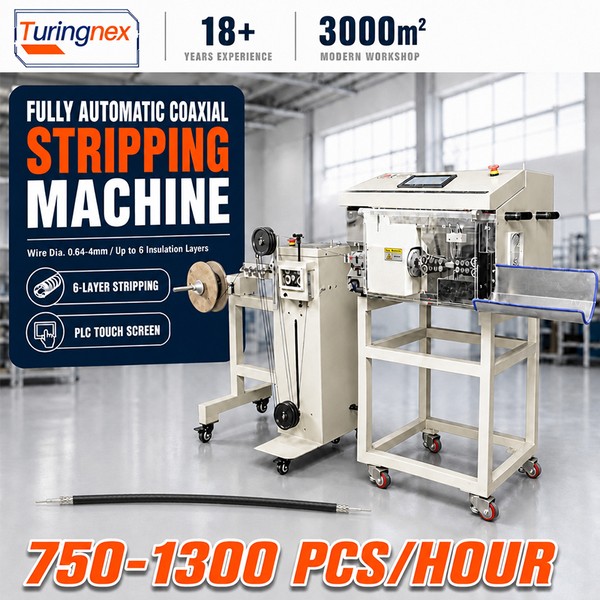
On the fully automatic side the TR-9800 handles a processing diameter of 0.64-3.5 mm with a right-end strip up to 200 mm, six layers, and 750-1300 pieces per hour. The TR-9600S takes 1.0-5.5 mm as standard (1.5-8.5 mm to order) and stores up to 100 parameter sets.
The parameter that usually decides it
Cut length. A semi-automatic machine is fed pieces that are already cut to length, so a 5 m coaxial run has to be cut on a separate machine first and then handled twice. The fully automatic machines quote cutting capacities in the metres — 22-9999 mm on the TR-9800, and up to 10 m or 50 m on the larger TR-9935 — which is the whole point of the category.
| Model | Type | Processing diameter | Max. strip | Layers | Output | Weight |
|---|---|---|---|---|---|---|
| TR-9800 | Fully automatic | 0.64-3.5 mm | 200 mm right / 45 mm left | 6 | 750-1300 pcs/h | 100 kg |
| TR-9600S | Fully automatic | 1.0-5.5 mm (1.5-8.5 mm custom) | 100 mm right / 45 mm left | 6 | 300-850 pcs/h | 120 kg |
| TR-9935 | Fully automatic, large | 5-24 mm | 1 mm-10 m / 1 mm-50 m | — | 350-750 pcs/h | 375 kg |
| TR-5806 | Semi-automatic | 0.8-7 mm | 0-56 mm | 9 | 750-1150 pcs/h | 26 kg |
| TR-6806D | Semi-automatic | 1.5-9.5 mm | 0-65 mm | 9 | 700-1200 pcs/h | 28 kg |
Where semi-automatic is the better buy
Three situations. High layer counts on short leads, where the nine-layer capability matters more than throughput. Mixed production, where the setup for one cable type has to change several times a shift and a 26 kg bench machine can be re-set faster than a reel-fed line. And low volume, where the capital saved buys a separate cut-to-length machine and still leaves money over.
The semi-automatic models store up to 99 parameter sets, which is worth noting: changing from one cable type to another is a recall, not a re-programme.
The layers a rotary head cannot finish
On shielded new-energy cable the hard part is not the jacket, it is what sits under it. Aluminium foil has to be removed without being pushed back into the braid, and the braid has to be cut without cutting the inner jacket, then folded back.
For braid alone, a single-station braid cutting machine covers 3-70 mm² with a braid cut length of 5-100 mm and output of 300-500 pieces per hour. For the full sequence in one machine — outer jacket, laser foil removal, braid cutting, braid folding, inner jacket — the five-station solution handles 3-70 mm² at 200-250 pieces per hour with a stated yield of 98 percent. That is a different class of machine and a different order of capital, justified only where the sequence is standard for the customer.
What to send
Send 2-3 m of each cable with the cut length and the layer breakdown, and say whether the cable arrives on a reel. If it arrives cut to length, the fully automatic machines are being under-used; if it arrives on a reel and the batch is large, the semi-automatic ones add a handling step. That single question — who cuts it to length — answers most of the choice.